

Gender and Development (GAD) Office
The Gender and Development (GAD) Office serves as the primary catalyst for gender-responsive governance within our institution. Tasked with the strategic implementation of RA 9710 and CMO 1, s. 2015, our office leads the integration of gender perspectives across instruction, research, and community extension.
We function as the institutional technical expert, providing guidance on Gender Mainstreaming, facilitating specialized training, and overseeing the Committee on Decorum and Investigation (CODI). Our goal is to cultivate a campus culture that is free from discrimination, where policy is backed by action, and every individual is empowered to reach their full potential.
ORGANIZATIONAL STRUCTURE
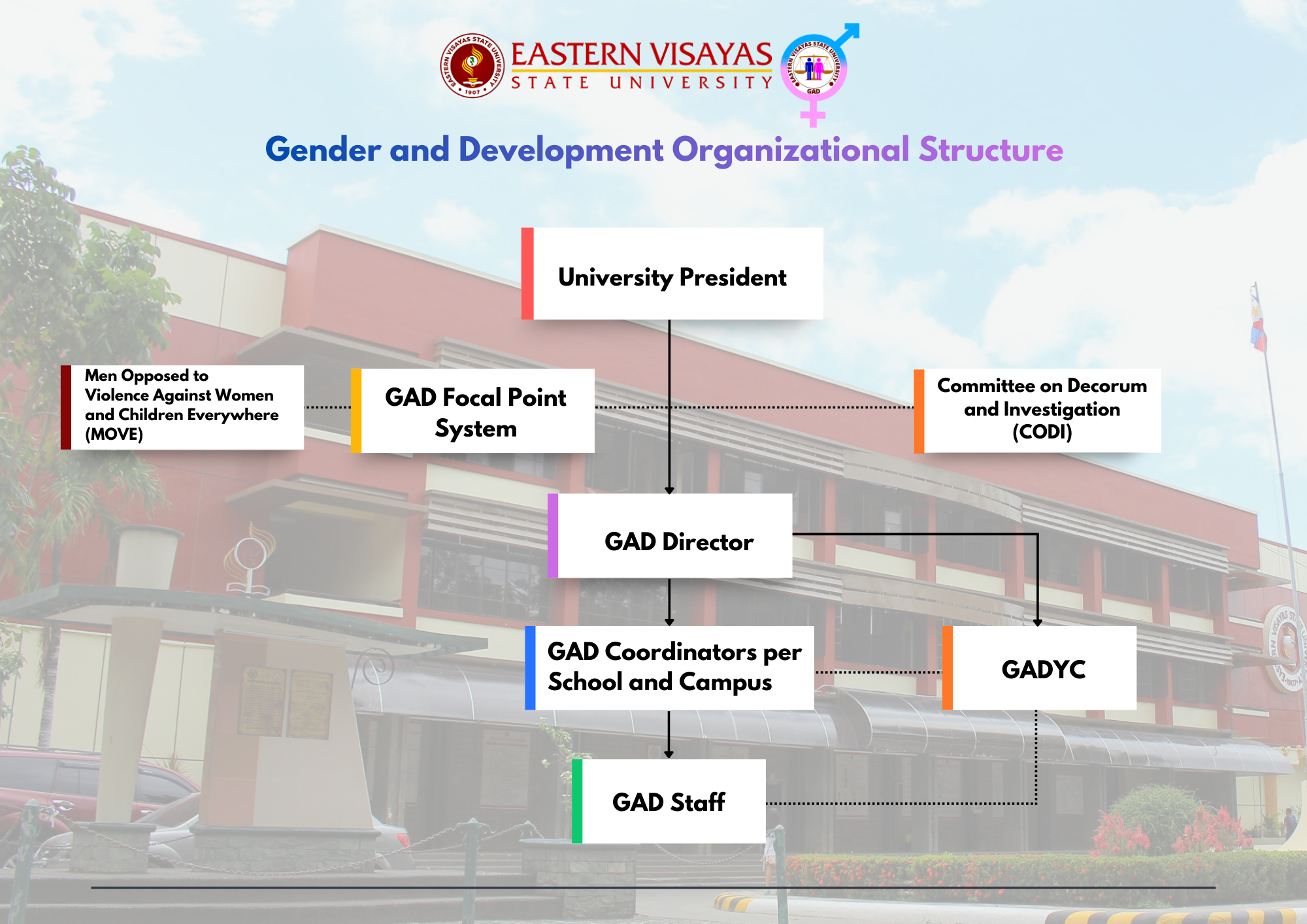
The Gender and Development (GAD) Office of the Eastern Visayas State University (EVSU) is institutionally designed to operationalize gender mainstreaming across all levels of university governance. Its organizational structure reflects the mandates of Republic Act No. 9710 (Magna Carta of Women), which requires government agencies, including State Universities and Colleges (SUCs), to establish a Gender and Development Focal Point System (GFPS), and the provisions of the EVSU University Code Chapter 48, Article 119, which formally integrates GAD into the university’s administrative framework.
At the highest level of authority, the University President who is also the Chair of the GFPS, exercises overall leadership and policy direction over the GAD mechanism. This positioning ensures that gender and development concerns are embedded in executive decision-making and institutional planning, thereby affirming that GAD is a core governance function rather than a peripheral activity.
Directly under the University President is the GAD Focal Point System (GFPS), which serves as the central policy and coordination mechanism for gender mainstreaming. The GFPS functions as an inter-office and inter-sectoral body composed of key officials and representatives from various academic and administrative units. Its strategic placement allows the GAD agenda to influence institutional policies, programs, and resource allocation across the university system. Further, the GFPS catalyzes gender mainstreaming initiatives of the university enshrined in CMO 1 S. 2015.
The GAD Director operates as the technical and operational head of the GAD Office and acts as the primary link between executive leadership and operational units. Reporting directly to the University President, the GAD Director ensures coherence between national gender policies, university regulations, and campus-level implementation. This role is crucial in translating policy commitments into concrete gender-responsive actions.
At the implementation level, GAD Coordinators per School and Campus form the decentralized structure of the GAD Office. This design allows gender mainstreaming to be contextualized and responsive to the specific needs of individual schools/colleges, campuses, and academic units. The coordinators serve as institutional change agents who integrate gender perspectives into instruction, research, extension, and student services.
Supporting these roles are the GAD Staff, who provide the administrative, technical, and logistical backbone of the GAD Office. Their inclusion in the organizational structure ensures continuity, documentation, and sustainability of GAD initiatives.
The structure is further strengthened by allied and complementary bodies that have functional linkages with the GAD Office. These include the Committee on Decorum and Investigation (CODI), which addresses gender-based misconduct and sexual harassment; the GAD Youth Council (GADYC), which institutionalizes student participation in GAD advocacy; and Men Opposed to Violence Against Women and Children Everywhere (MOVE), which engages men as partners in gender equality. These linkages underscore the multi-sectoral and inclusive nature of EVSU’s GAD mechanism.
Overall, the organizational structure of the EVSU GAD Office is hierarchical yet participatory, combining strong executive leadership, technical coordination, decentralized implementation, and stakeholder engagement. This structure ensures that gender mainstreaming is sustained, accountable, and responsive across the entire university system.
THE RESPONSIBILITIES AND FUNCTIONS

The University President
At the apex of the GAD organizational structure is the University President, who serves as the overall head and chief policy authority of the GAD mechanism, the Chair of the GFPS with the following responsibilities:
- Provides strategic leadership and institutional commitment to gender and development, as required under RA 9710, which mandates all government agencies and SUCs to mainstream gender concerns in governance.
- Approves and supports the GAD policies, plans, and budgets, ensuring that gender equality is integrated into the university’s vision, mission, and strategic goals.
- Exercises oversight over the GAD Focal Point System (GFPS) and ensures that all university units comply with national and institutional GAD mandates.
- As provided in the EVSU University Code, ensures that GAD initiatives are institutionalized and sustained through appropriate administrative issuances and resource allocation.

The GAD Focal Point System (GFPS)
The GAD Focal Point System is the central coordinating and policy-recommending body for gender mainstreaming within EVSU, as required under RA 9710 and PCW guidelines.
Responsibilities and Functions:
- Serves as the primary mechanism for planning, implementing, monitoring, and evaluating GAD initiatives across the university.
- Ensures that gender perspectives are integrated into policies, programs, projects, and activities (PPAs) of academic and administrative units.
- Recommends gender-responsive strategies to university management based on gender analysis and assessment.
- Coordinates with key university offices (planning, budgeting, HR, student services) to ensure compliance with GAD-related laws and policies.
The GFPS embodies the RA 9710 requirement that gender mainstreaming must be a collective institutional responsibility, not confined to a single office.

The GAD Director
The GAD Director, directly reporting to the University President, is the technical and operational head of the GAD Office.
Responsibilities and Functions:
- Oversees the planning, implementation, and monitoring of the university’s GAD Plan and Budget (GPB) in coordination with the GFPC per School and Campus
- Coordinates the work of the GAD Focal Point Committee and GAD Coordinators, GAD Staff, and allied units such as CODI, GADYC, and MOVE.
- Represents EVSU in inter-agency and external GAD-related partnerships, linkages, and capacity-building activities.
- Ensures the generation and use of sex-disaggregated data and gender statistics for evidence-based planning and reporting in coordination with the Committee on Knowledge Management System as in charge of the EVSU GAD Database
Under the University Code, the GAD Director facilitates institutionalizing the gender mainstreaming initiatives in EVSU across instruction, research, extension, and administration.

The GAD Coordinators
The GAD Coordinators serve as the frontline implementers of GAD initiatives in schools and satellite campuses.
Responsibilities and Functions:
- Coordinate the localization of GAD programs and activities within their respective units.
- Facilitate in the preparation of the GPB in close coordination with the GAD Focal Point Committee per School and Campus
- Assist in the identification of gender issues and concerns at the college or campus level through gender analysis and school/campus level gender statistics.
- Facilitate the integration of gender perspectives into academic programs, student services, research, and extension activities.
- Monitor and report GAD accomplishments and challenges to the GAD Director.
- Serve as advocates and resource persons for gender sensitivity and awareness activities.
This decentralized structure supports RA 9710’s mandate for institution-wide gender mainstreaming.

GAD Staff
The GAD Staff provide essential administrative, technical, and logistical support to the GAD Office.
Responsibilities and Functions:
- Assist in the documentation, coordination, and implementation of GAD activities and programs.
- Support the preparation of GAD reports, databases, and compliance documents required by oversight agencies.
- Maintain records, communications, and logistics related to GAD initiatives.
- Provide operational support to GAD Coordinators, CODI, and student-led GAD organizations.
Their role ensures the efficient and continuous operation of the GAD Office.

Committee on Decorum and Investigation (CODI)
The Committee on Decorum and Investigation (CODI) is a key allied mechanism linked to the GAD Office, consistent with RA 9710 and related laws on gender-based violence. The 2017 Revised Code of the Eastern Visayas State University (Chapter 48, Article 126, Section 543) requires the creation of CODI pursuant to Civil Service rules and regulations who shall perform the following functions.
Responsibilities and Functions:
- Handles/receives complaints related to sexual harassment and gender-based misconduct within the university.
- Conducts investigations and recommends appropriate actions, ensuring due process and confidentiality.
- Submit a report of its findings with the corresponding recommendation to the disciplining authority for decision
- Works closely with the GAD Office in promoting a safe, respectful, and gender-sensitive learning and working environment.
- Leads in the conduct of discussions about sexual harassment within the agency or institution to increase understanding and prevent incidents of sexual harassment
- Supports the university’s compliance with laws protecting women and other gender groups from violence and discrimination.

GAD Youth Council (GADYC)
The GAD Youth Council (GADYC) represents student participation in gender and development initiatives.
Responsibilities and Functions:
- Serves as a platform for student engagement and leadership in promoting gender equality.
- Initiates and supports advocacy campaigns, peer education, and awareness activities on gender issues.
- Collaborates with the GAD Office in implementing youth-focused GAD programs.
- Ensures that the voices and concerns of students are reflected in institutional GAD initiatives
This aligns with RA 9710’s emphasis on inclusive participation, particularly of young people.

Men Opposed to Violence Against Women and Children Everywhere (MOVE)
The MOVE organization complements the GAD structure by engaging men as partners in gender equality.
Responsibilities and Functions:
- Advocates for the prevention of violence against women and children through education and awareness.
- Supports GAD campaigns promoting positive masculinity and shared responsibility.
- Works with the GAD Office and CODI to strengthen institutional responses to gender-based violence.
MOVE operationalizes RA 9710’s principle that men must be active partners in achieving gender equality.
The GAD Office organizational structure of EVSU reflects a comprehensive, participatory, and legally compliant framework for gender mainstreaming. Anchored on RA 9710 and institutionalized through the EVSU University Code, the structure ensures leadership accountability, technical coordination, decentralized implementation, and broad stakeholder engagement. Through this mechanism, EVSU effectively advances gender equality, protects the rights of women and marginalized genders, and promotes a safe, inclusive, and gender-responsive academic community.