

Gender-Responsive Workforce Data
Sex-Disaggregated Data (SDD) for employees is essential for understanding workforce dynamics through a gender lens, allowing organizations to identify gaps in recruitment, promotions, training, and compensation. By breaking down employee information by sex, SDD provides evidence-based insights that guide gender-responsive decision-making, helping leaders implement targeted policies and initiatives that promote equity and inclusivity. This data-driven approach ensures that organizational strategies are not only well-intentioned but also measurable, transparent, and effective in fostering a fair and balanced workplace for all employees.
EVSU Employees by Sex (First Semester 2025-2026)
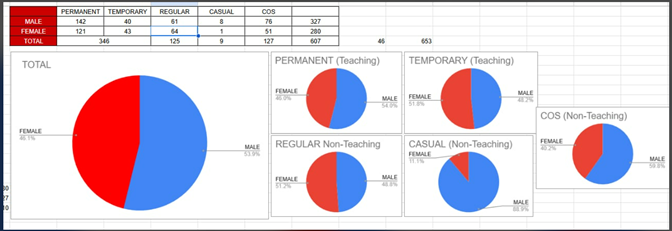
Figure 1. EVSU Employees by Sex (First Semester 2025-2026)
The data shows a generally balanced gender distribution in the institution (53.9% male, 46.1% female), with near parity in teaching positions, particularly in permanent and regular roles, which aligns with the intent of RA 9710 (Magna Carta of Women) to ensure equal access to employment and non-discriminatory participation of women in public institutions. However, notable gender disparities persist in certain non-teaching categories, especially in casual and COS positions, where males are disproportionately represented. In light of CHED CMO No. 1, s. 2015, which mandates gender mainstreaming and the use of sex-disaggregated data in higher education institutions, these findings imply the need for targeted gender-responsive policies, particularly in recruitment, job assignment, and employment conditions for non-teaching staff to address structural imbalances and promote more equitable opportunities for both women and men across all employment categories.
SDD for Permanent Faculty
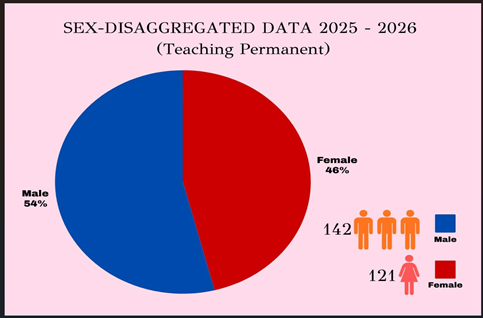
Figure 2. SDD of Permanent Faculty
The sex-disaggregated data for Permanent Faculty (AY 2025–2026) shows a near-balanced distribution, with 54% male (142) and 46% female (121). This indicates that women have substantial access to stable, tenure-track academic positions, which is consistent with the mandate of RA 9710 (Magna Carta of Women) to ensure equal opportunity, non-discrimination, and security of tenure for women in public institutions. While a slight male predominance remains, the gap is not pronounced and does not suggest systemic exclusion. In line with CHED CMO No. 1, s. 2015, the use of sex-disaggregated data highlights the institution’s progress in gender mainstreaming within its core academic workforce, while also pointing to the need for continued gender-responsive policies such as equitable promotion, leadership development, and capacity-building programs to ensure that women’s representation in permanent teaching roles is sustained and strengthened, particularly in higher academic ranks and decision-making positions.
Permanent teaching positions are slightly male-dominated, but the gap is small. This suggests near gender parity in long-term teaching roles, which is a positive indicator of equity in stable academic employment.
SDD for Temporary Faculty
The sex-disaggregated data for our Temporary Faculty for AY 2025–2026 shows a slight female majority, with 51.8% female (43) and 48.2% male (40). This reflects women’s active participation and access to teaching opportunities, consistent with RA 9710 (Magna Carta of Women), which upholds women’s right to equal access to employment in public institutions. However, the concentration of women in temporary rather than permanent teaching positions may also suggest potential gendered patterns in employment security. In line with CHED CMO No. 1, s. 2015, this underscores the importance of using sex-disaggregated data to inform gender-responsive human resource policies, particularly in ensuring fair pathways for women’s transition from temporary to permanent teaching roles through equitable hiring, promotion, and professional development mechanisms.
Temporary teaching positions show a female majority. This may indicate that women are more represented in short-term or contractual teaching roles, which could reflect hiring patterns, availability, or career progression dynamics.
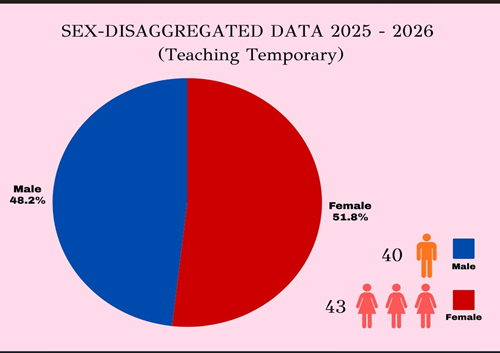
Figure 3. SDD of Temporary Faculty
SDD for Non-Teaching Regular and Casual Employees
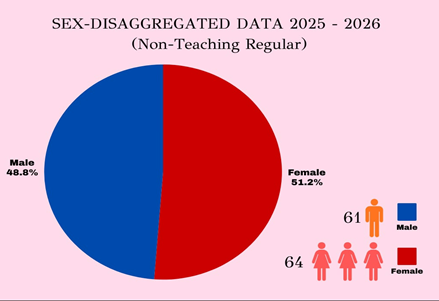
Figure 4. SDD of Regular Non-Teaching Staff
Regular non-teaching roles are slightly female-dominated, suggesting good gender balance and inclusivity in administrative or support positions.
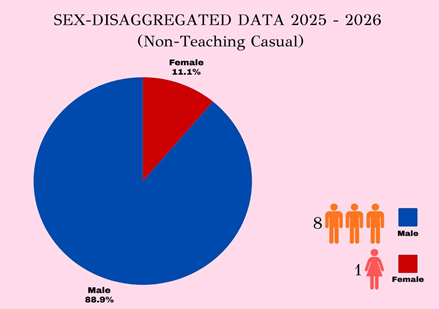
Figure 5. SDD of Casual Non-Teaching Staff
Casual non-teaching positions are heavily male-dominated. This sharp imbalance may reflect the nature of casual work (e.g., physically demanding or short-term tasks) or gendered role allocation.
SDD for Non-Teaching COS Employees
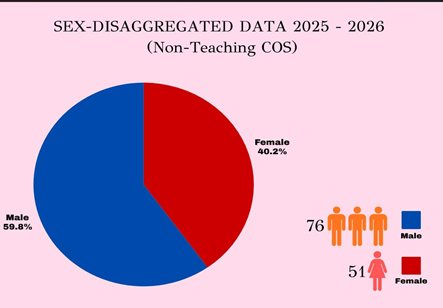
Figure 6. SDD of COS
COS positions show a clear male majority, though not as extreme as casual roles. This suggests males are more represented in contract-based non-teaching employment.
Overall, the institution demonstrates a generally healthy gender balance, with no pronounced or extreme disparities in the total workforce. Teaching positions, particularly those classified as permanent and temporary, reflect near gender parity, indicating equitable access of women and men to academic roles and suggesting positive outcomes of inclusive employment practices. In contrast, notable gender imbalances persist in certain non-teaching categories, especially in casual positions where males are overwhelmingly represented. Women tend to be more visible in temporary teaching appointments and regular non-teaching roles, while men continue to dominate casual and Contract of Service (COS) non-teaching positions. These patterns point to the need for closer examination of employment arrangements and role assignments to ensure that gender equity is consistently upheld across all staff categories pursuant to RA 9710 and CMO 1 S 2015.
EVSU Employees by Sex (2019-2024)
| YEAR | MALE | FEMALE |
|---|---|---|
| 2019 | 571 | 519 |
| 2020 | 644 | 603 |
| 2021 | 666 | 602 |
| 2022 | 750 | 650 |
| 2023 | 666 | 640 |
| 2024 | 673 | 642 |
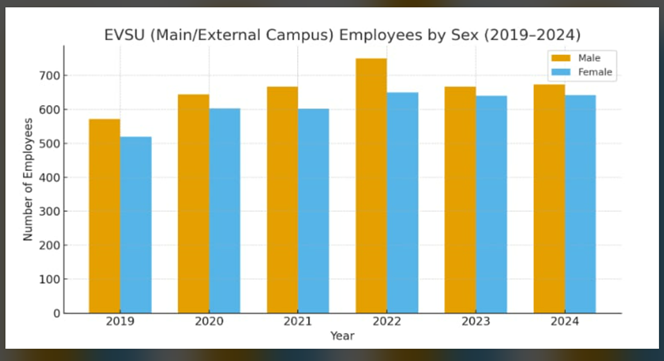
Figure 1. EVSU Employees by Sex
Between 2019 and 2024, the company experienced notable overall growth in its workforce. The number of male employees rose from 571 to 673, marking an increase of 102 individuals. Meanwhile, the female employee count grew from 519 to 642, adding 123 more employees over the same period.
Gender Gap
Throughout the years from 2019 to 2024, male employees consistently outnumbered female employees. However, the gender gap has been steadily narrowing. In 2019, the difference between the number of male and female employees was 52, with 571 males compared to 519 females. By 2024, this gap had decreased to 31, with 673 males and 642 females.
The year 2022 marked the peak in employee numbers for both male and female staff, with male employees reaching their highest count of 750 and female employees hitting 650. This surge could be attributed to factors such as company expansion, the introduction of new programs, or targeted hiring initiatives. However, in 2023, the workforce saw a noticeable decline. The number of male employees fell from 750 to 666, while female employees decreased slightly from 650 to 640. This reduction may indicate increased attrition, retirements, or potential budget cuts during that year.
From 2019 to 2024, EVSU steadily expanded its workforce, reflecting a period of sustained growth. Throughout these years, male employees consistently outnumbered female employees, yet the gap between the two genders gradually narrowed, signaling progress toward a more balanced workforce. Staffing numbers reached their highest point in 2022, but this peak was followed by a noticeable decline in 2023, which could point to organizational changes such as restructuring or resource adjustments. The slight increase in employee numbers in 2024 suggests a recovery or stabilization after this downturn, indicating that the organization may be adapting and regaining momentum.