

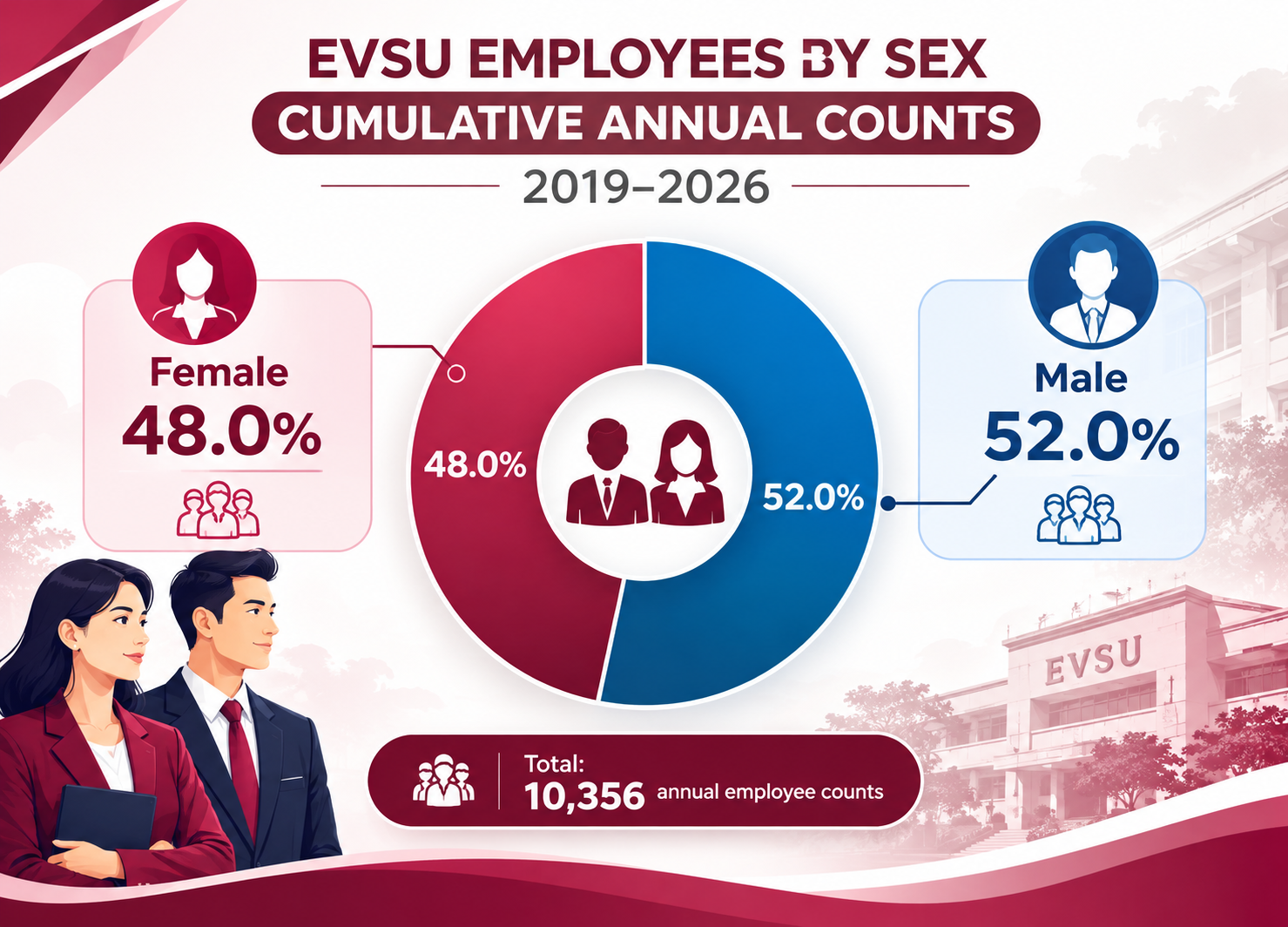
| YEAR | MALE | FEMALE | TOTAL |
|---|---|---|---|
| 2019 | 571 | 519 | 1090 |
| 2020 | 644 | 603 | 1247 |
| 2021 | 666 | 602 | 1268 |
| 2022 | 750 | 650 | 1400 |
| 2023 | 666 | 640 | 1306 |
| 2024 | 673 | 642 | 1315 |
| 2025 | 665 | 627 | 1292 |
| 2026 | 754 | 684 | 1438 |
| TOTAL | 5389 | 4967 | 10356 |
The sex-disaggregated employee data from 2019 to 2026 provide an important institutional indicator of gender representation and participation in the workforce. In the context of Eastern Visayas State University (EVSU), these figures offer a basis for assessing the university’s commitment to gender equality, equal employment opportunities, inclusive institutional governance, and the empowerment of women in the workplace.
Overall Gender Representation in the Workforce
For the eight-year period, the university recorded a total of 10,356 employee counts, consisting of 5,389 males (52.05%) and 4,967 females (47.95%).
Male employees account for a 4.07-percentage-point higher share than female employees. The data indicate a relatively balanced distribution of male and female employees, with only a 4.07-percentage-point difference between the two groups. This suggests that women’s participation in the university workforce is substantial and that female employees constitute nearly half of the institution’s personnel.
From an SDG 5 perspective, this representation is a positive indicator of women’s access to employment and participation in the university’s institutional operations. It also provides an opportunity for EVSU to further strengthen gender-responsive human resource policies and ensure that women and men enjoy equal opportunities for recruitment, professional development, career advancement, leadership, and decision-making. However, numerical representation alone does not establish the full extent of gender equality. The university must also examine whether women and men have equitable access to permanent positions, promotions, leadership appointments, professional training, and other institutional opportunities.
Trends in Male and Female Employee Participation, 2019–2026
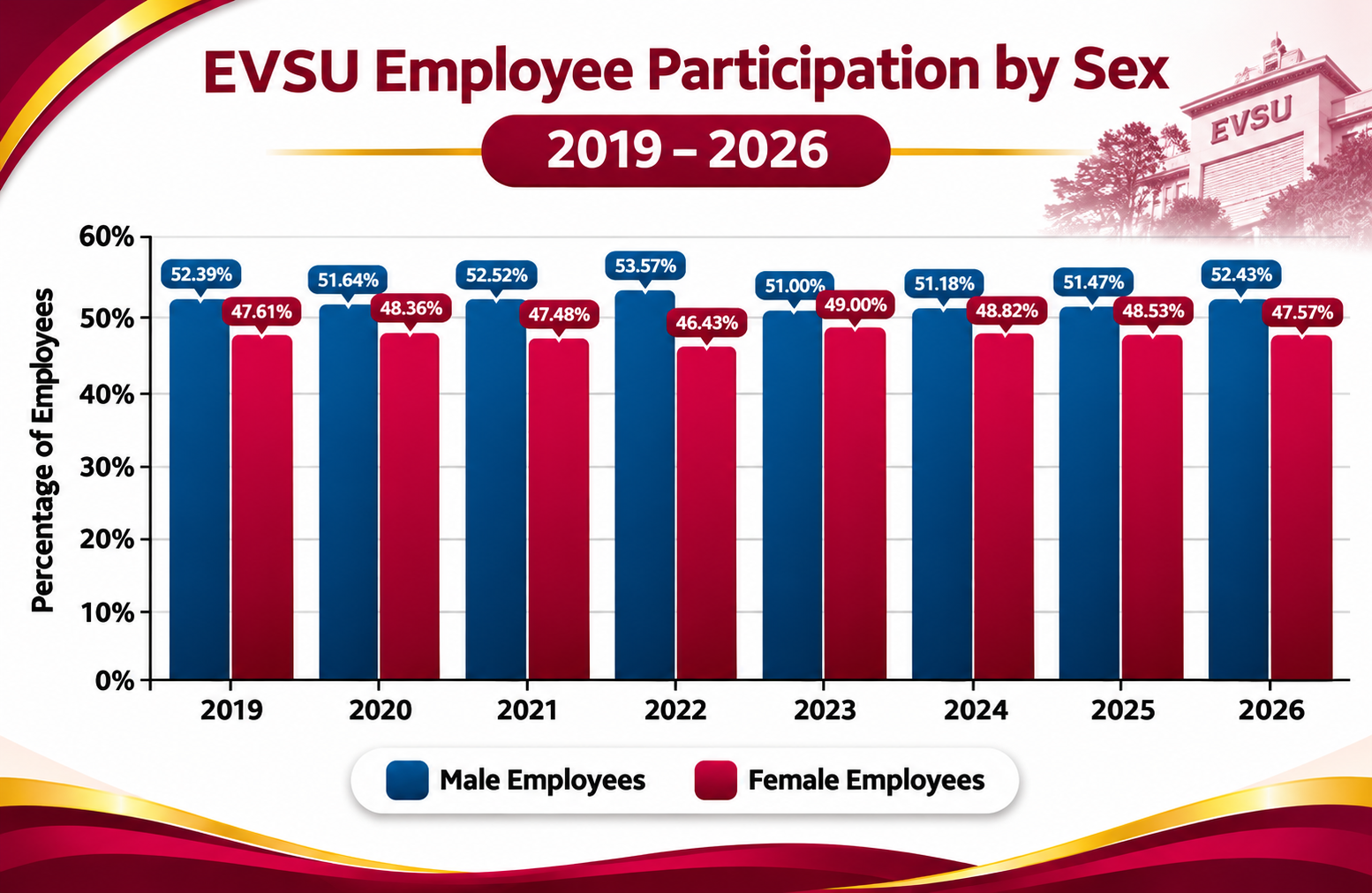
| YEAR | MALE (%) | FEMALE (%) |
|---|---|---|
| 2019 | 52.39% | 47.61% |
| 2020 | 51.64% | 48.36% |
| 2021 | 52.52% | 47.48% |
| 2022 | 53.57% | 46.43% |
| 2023 | 51.00% | 49.00% |
| 2024 | 51.18% | 48.82% |
| 2025 | 51.47% | 48.53% |
| 2026 | 52.43% | 47.57% |
An examination of the annual figures reveals that male employees consistently outnumbered female employees throughout the reporting period. Nevertheless, the difference between the two groups remained relatively narrow.
Looking at these trends, the following are observed:
- Relatively balanced workforce participation. Female representation remained between 46.43% and 49.00% across the eight-year period. This indicates sustained participation of women in the university workforce.
- Improvement in gender representation in 2023. Female representation reached its highest level at 49%, reducing the difference between male and female employees to only 26 employees. This suggests a particularly favorable year in terms of workforce representation.
- Fluctuations in gender representation. The highest male representation was recorded in 2022 at 53.57%, while female representation was lowest at 46.43%. The figures subsequently moved toward a more balanced distribution in 2023 and 2024.
- Continued opportunity for improvement. In 2026, male employees numbered 754, compared with 684 female employees. Although the overall difference remains relatively modest, continued monitoring is necessary to ensure that women’s participation is sustained and translated into equitable employment opportunities.
The findings demonstrate that women’s participation in EVSU’s workforce has remained relatively consistent. Nevertheless, the university should move beyond maintaining numerical representation toward addressing possible structural and institutional barriers that may affect women’s career progression, professional recognition, and leadership participation.
Institutional Assessment of Women’s Representation and Leadership
This is a particularly important dimension that requires further institutional assessment. While the data demonstrate women’s presence in the workforce, they do not establish whether women are equally represented in administrative positions, academic leadership, supervisory roles, and strategic decision-making bodies.
EVSU should therefore examine the sex distribution of:
- University administrators and academic officials;
- Deans, directors, department chairs, and program heads;
- Supervisory and managerial positions;
- Members of institutional committees and policy-making bodies; and
- Employees occupying plantilla, contractual, and other employment categories.
Such analysis will help determine whether women’s substantial workforce participation is matched by their representation in positions of authority and influence. The data provide an empirical foundation for strengthening gender-responsive institutional policies and programs. These include gender-responsive human resource management, equal access to professional development, gender-fair performance evaluation, workplace protection against sexual harassment and discrimination, and institutional mechanisms that promote work-life balance. These initiatives are consistent with the principles of Republic Act No. 9710, or the Magna Carta of Women, which calls for substantive equality and the elimination of discrimination against women.
Gender Mainstreaming and Strategic Institutional Interventions
In the context of EVSU, the findings should not be viewed merely as personnel statistics but as a management and planning instrument for gender mainstreaming. The nearly balanced distribution of male and female employees provides a favorable starting point for institutionalizing gender-responsive human resource management. However, substantive gender equality requires examining the quality of employment, distribution of opportunities, and conditions under which employees perform their institutional responsibilities.
In this regard, the GAD Office, in collaboration with the Human Resource Management Office and the Gender and Development Focal Point System (GFPS), may consider the following strategic interventions:
- Gender-Responsive Recruitment and Selection. Institutionalize gender-fair recruitment and selection practices and regularly assess employment patterns across academic and non-academic units.
- Women’s Leadership and Career Advancement. Develop capacity-building and leadership development initiatives that encourage women’s participation in administrative and academic leadership.
- Gender-Responsive Workplace Policies. Strengthen policies addressing work-life balance, parental responsibilities, lactation support, safe spaces, and protection against sexual harassment and gender-based discrimination.
- Equal Access to Professional Development. Monitor the participation of male and female employees in scholarships, trainings, conferences, research opportunities, and professional advancement programs.
- Institutional Gender Audit and Monitoring. Conduct periodic analysis of sex-disaggregated personnel data to identify possible gender gaps and inform evidence-based GAD planning and budgeting.
Conclusion: Advancing Gender Equality Through Institutional Empowerment
The 2019–2026 sex-disaggregated employee data demonstrate that Eastern Visayas State University has maintained a relatively balanced workforce in terms of male and female representation. Of the 10,356 cumulative annual employee counts, approximately 52.04% were male and 47.96% were female. The relatively narrow representation gap indicates that women have maintained a substantial presence in the university’s workforce throughout the reporting period.
From the perspective of SDG 5, this is an important institutional baseline reflecting women’s participation in the university’s employment structure. It also provides an opportunity for EVSU to strengthen its commitment to gender equality by ensuring that women’s participation is accompanied by equal access to opportunities, professional growth, institutional recognition, leadership, and decision-making.
Ultimately, gender equality in the workplace should not be measured solely by how many women are employed, but also by how equitably they are represented, empowered, supported, and enabled to influence institutional development.
Through sustained gender mainstreaming, evidence-based GAD planning, and gender-responsive human resource policies, EVSU can transform workforce representation into meaningful institutional empowerment and contribute more substantially to the achievement of SDG 5.