
SDG 13 | CLIMATE ACTION
Co-operative Climate Disaster Preparedness and Resilience Planning
The Eastern Visayas State University (EVSU) recognizes that effective climate disaster preparedness and resilience planning require coordinated action, shared responsibility, and sustained collaboration among universities, government agencies, local government units, communities, and other stakeholders. Given the vulnerability of Eastern Visayas to climate-related hazards, including typhoons, flooding, storm surges, and other extreme weather events, the University actively engages in collaborative initiatives that strengthen disaster preparedness, improve early warning and response mechanisms, and enhance the adaptive capacities of communities. Through its academic expertise, research and extension capabilities, and institutional partnerships, EVSU contributes to the development and implementation of science-based and community-responsive strategies for disaster risk reduction and climate resilience. These efforts include collaborative early warning initiatives, climate and disaster risk awareness campaigns, capacity-building activities, flood mitigation and preparedness programs, and partnerships that facilitate coordinated emergency response and community recovery. By working with local government units, national government agencies, disaster response organizations, and other development partners, EVSU helps translate scientific knowledge and institutional resources into practical resilience-building interventions. These collaborative efforts reinforce the University’s commitment to protecting lives and livelihoods, reducing climate-related vulnerabilities, and advancing its vision of becoming a National University for Resiliency and Climate Action by 2040.
Cooperative Planning for Climate-Related Disasters, Disaster Risk Reduction,
and the Management of Displaced Communities
Eastern Visayas State University (EVSU) recognizes that climate change intensifies the frequency and severity of natural hazards, including typhoons, extreme rainfall, flooding, storm surges, and other climate-related emergencies that threaten lives, livelihoods, infrastructure, and community well-being. Given the vulnerability of Eastern Visayas to these hazards, the University actively engages in cooperative planning and collaborative initiatives with national government agencies, local government units (LGUs), disaster risk reduction and management offices, civil society organizations, and community stakeholders to strengthen disaster preparedness, climate adaptation, emergency response, and community resilience.
Through its institutional disaster risk reduction and management mechanisms, research and extension programs, technological innovations, and community engagement initiatives, EVSU contributes to developing and strengthening collaborative approaches to climate-related disaster management. These efforts extend beyond the University’s internal emergency preparedness arrangements, encompassing participation in multi-stakeholder consultations, technical cooperation with government agencies, capacity-building for local disaster management institutions, development of early-warning and evacuation support systems, and provision of temporary shelter and humanitarian assistance to communities displaced by extreme weather events.
EVSU–Multi-Stakeholder Climate Resilience Initiative: Collaborative Planning for Flood Mitigation, Disaster Preparedness, and Community Resilience
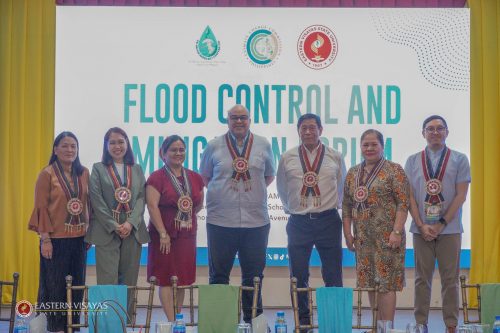
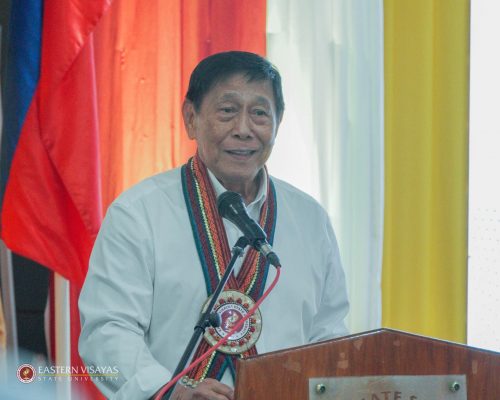
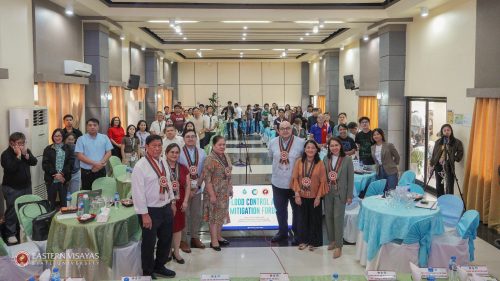
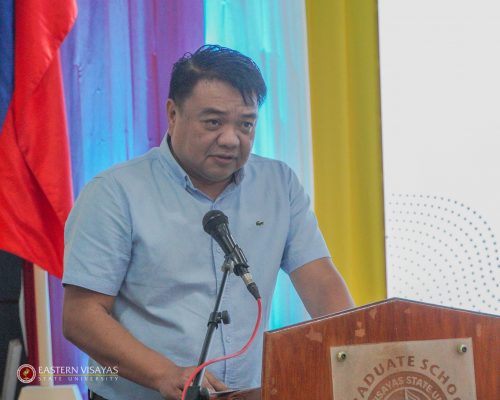
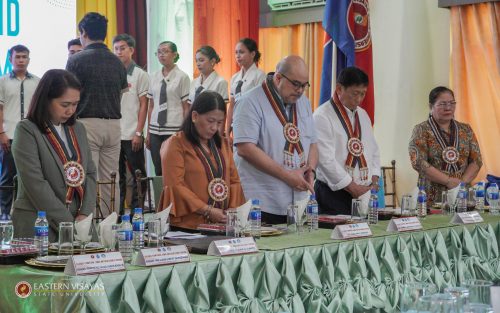
In 2025, a significant demonstration of EVSU’s participation in cooperative climate-disaster planning was its involvement in the Building Resilience Together Through Flood Control and Mitigation Forum, held on March 7, 2025, at the EVSU Graduate School Function Hall in Tacloban City. The forum brought together representatives from the Climate Change Commission (CCC), Tacloban City Government through its City Planning Office, Department of Environment and Natural Resources (DENR) Region VIII, Department of Public Works and Highways (DPWH) Region VIII, PH Haiyan, private-sector organizations, civil society groups, and community representatives.
The activity provided a multi-stakeholder platform for discussing the city’s exposure to flooding and identifying collaborative approaches to reducing climate-related risks. Discussions highlighted the importance of science-based flood mitigation measures, climate adaptation strategies, sustainable infrastructure interventions, environmental management, and active participation of communities in addressing local vulnerabilities. The participation of the Climate Change Commission also provided an opportunity to connect local flood mitigation concerns with national climate adaptation priorities, including the National Adaptation Plan.
Through this initiative, EVSU demonstrated its commitment to contributing academic and technical perspectives to local climate resilience discussions. The University also highlighted its Learning Institute for Environment (LIFE), which promotes environmental awareness and the mainstreaming of Disaster Risk Reduction and Management (DRRM). The forum was envisioned as the beginning of continuing engagements and initiatives directed toward addressing flooding and strengthening the city’s long-term resilience.
This initiative illustrates EVSU’s role as an academic institution and development partner that brings together government institutions, civil society, the private sector, and communities to discuss shared climate-related vulnerabilities and identify appropriate mitigation and preparedness interventions.
EVSU–Government Partnership for Cooperative Climate Disaster Planning and Resilience

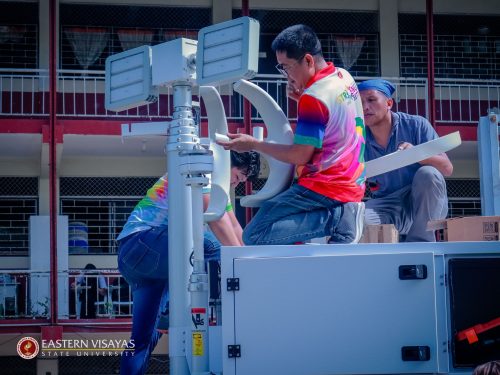
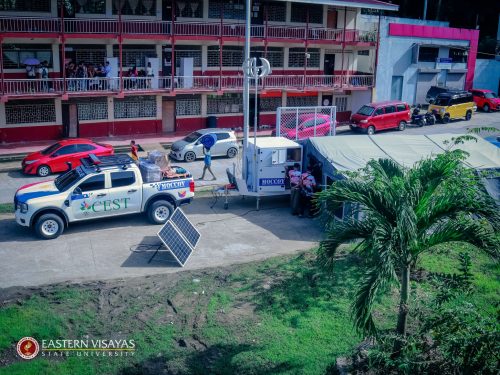
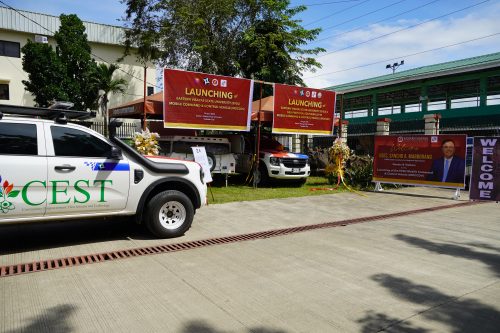
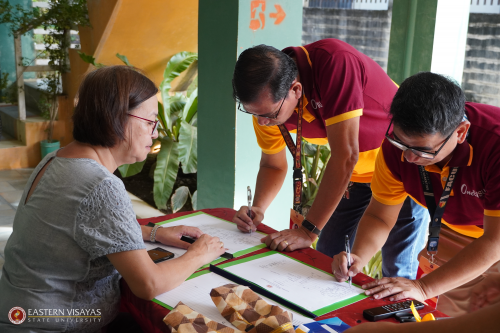
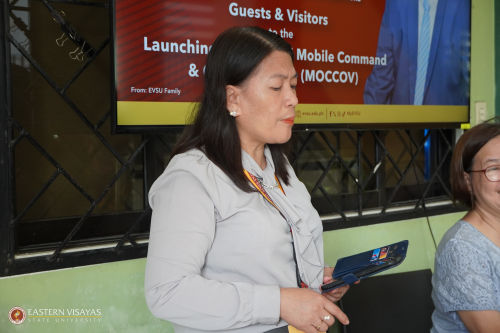
EVSU further strengthened its contribution to regional disaster preparedness through its partnership with the Department of Science and Technology (DOST) under the project entitled Application of Science, Technology, and Innovation for the Enhancement of Disaster Risk Reduction and Management in Region 8. This collaboration recognizes the importance of integrating scientific knowledge, technological innovations, and coordinated government action into disaster preparedness and emergency response systems.
A major output of this partnership was the development and deployment of the Mobile Command and Control Vehicle (MoCCoV), which was officially launched on April 10, 2025. Designed as a mobile emergency operations platform, MoCCoV provides capabilities that support real-time information gathering, situational monitoring, GPS tracking, secure communications, and coordination of emergency response activities.
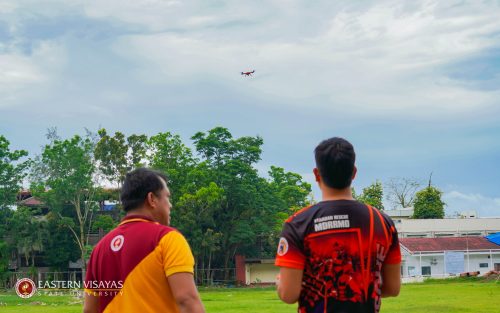
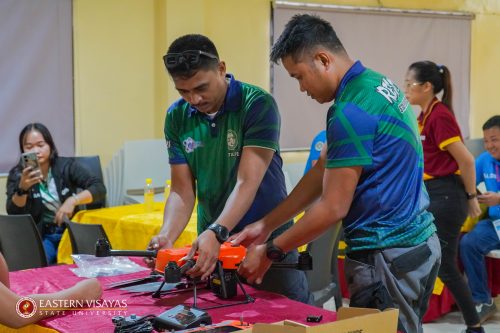
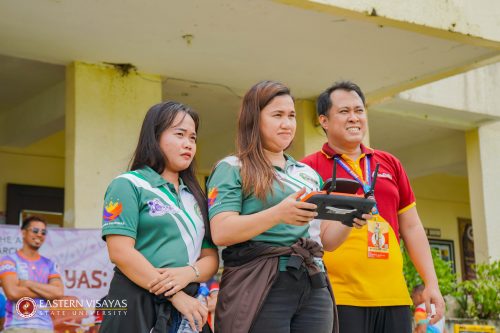
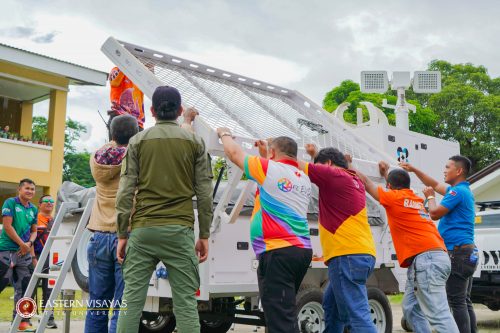
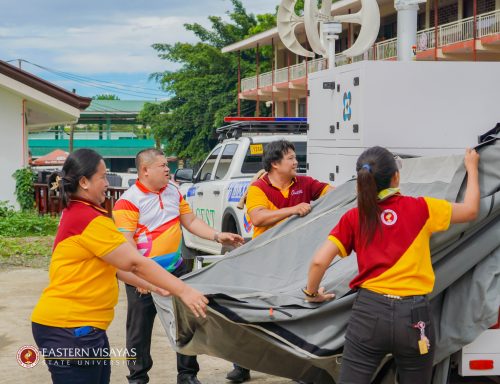
The availability of this mobile command facility strengthens the ability of disaster management institutions and emergency responders to obtain relevant field information, communicate during critical situations, and coordinate response operations. It also demonstrates how EVSU translates its research and technological capabilities into practical solutions that can support government-led disaster risk reduction and management initiatives.
Beyond the provision of technological infrastructure, EVSU, through its Office of Research and Development and Extension Services (ORDExS), conducted MoCCoV operations training on May 20, 2025, for Municipal Disaster Risk Reduction and Management Councils (MDRRMCs) from various municipalities. The training focused on strengthening the operational competencies of local disaster responders and familiarizing them with the use of the mobile command facility during emergency situations.
The capacity-building activity covered emergency communication systems, live-feed camera operations, drone-assisted surveillance and monitoring, Incident Command System (ICS) procedures, and field-based emergency response simulations. Through practical exercises, participating responders gained experience in utilizing technology for situational assessment, coordinating emergency personnel, and supporting organized response operations.
This collaboration is particularly significant because effective disaster management requires coordinated action across different levels of government. Municipal disaster management councils are responsible for local preparedness and response, while institutions such as EVSU can contribute research expertise, technological resources, and specialized training. Through the DOST partnership and direct engagement with municipal DRRM councils, EVSU helps strengthen the technical and institutional capacities necessary for more coordinated regional disaster preparedness.
EVSU–Government Coordination in Evacuation and Support for Displaced Communities
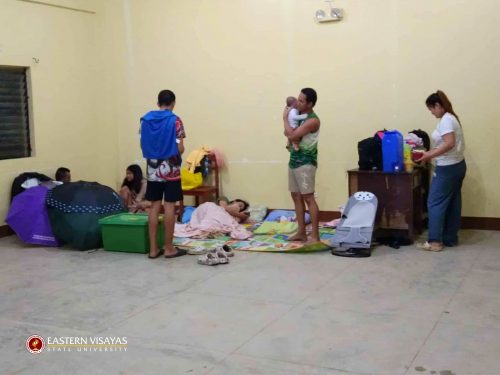
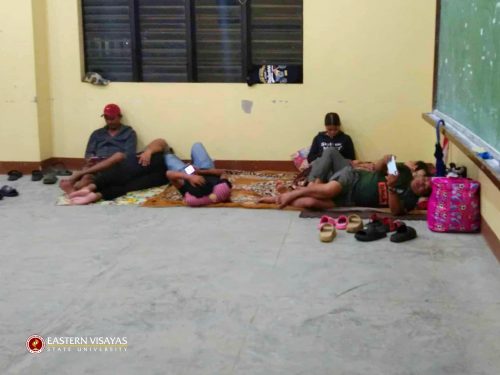
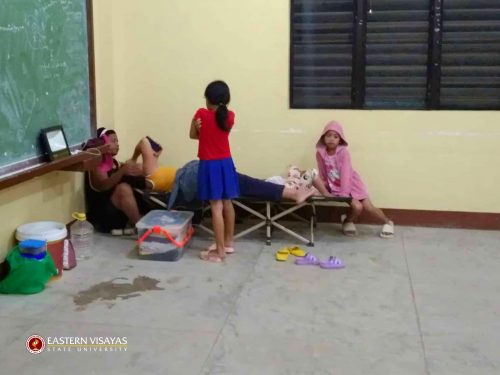
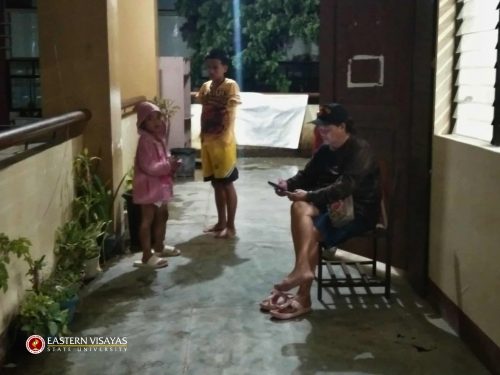
Eastern Visayas State University (EVSU) participates in cooperative disaster preparedness and response with local government and other public authorities by serving as a safe evacuation facility and coordinating the management and support of communities displaced by climate-related hazards. This role was demonstrated through the University’s coordinated response to Typhoons Opong, Tino, and Uwan in 2025, during which EVSU worked with local authorities and disaster-management agencies to provide temporary shelter, monitor conditions, manage evacuees, and deliver essential assistance.
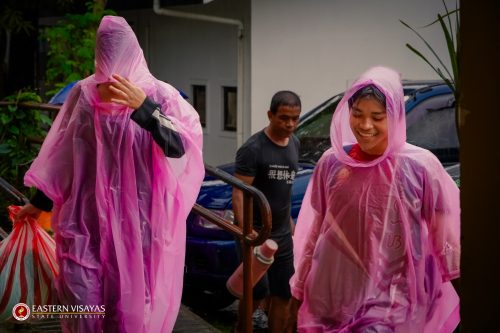
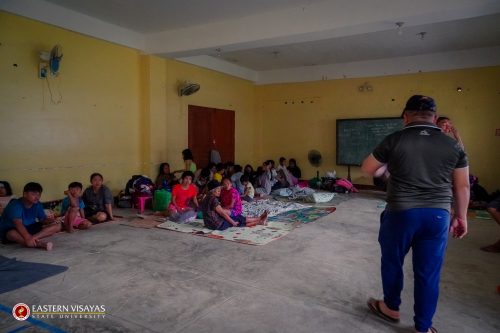
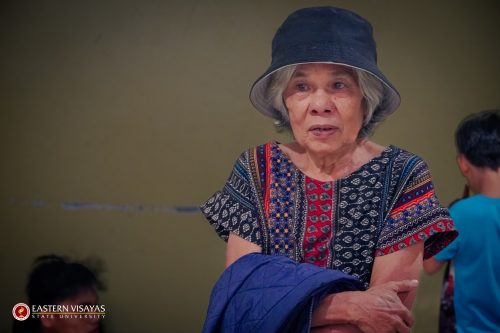
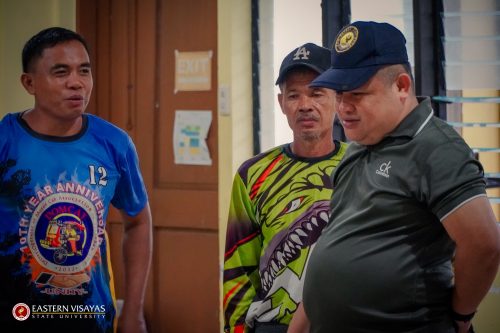
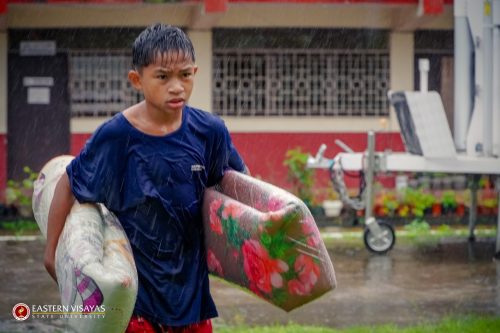
During Typhoon Opong in September 2025, EVSU opened its Main Campus to residents from nearby barangays who were forced to evacuate because of the severe weather. A total of 176 individuals sought temporary shelter at the University’s ABS-CBN Building. EVSU security personnel and campus staff ensured that the facility was safe and suitable for the displaced residents, while personnel from the Department of Social Welfare and Development (DSWD) conducted an initial assessment of evacuees’ needs, including food, water, and psychosocial support. Coordination among EVSU, DSWD, and local government units helped facilitate the orderly management of the evacuation site, with evacuees remaining on campus until authorities determined that conditions were safe for their return home.
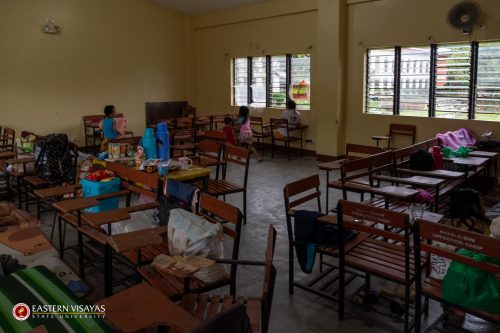
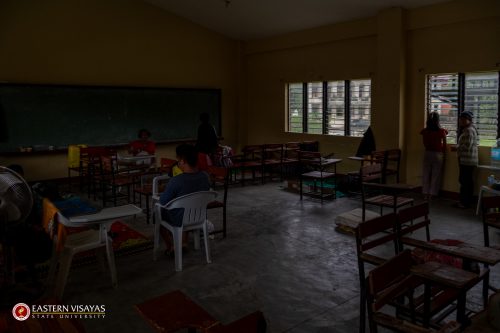
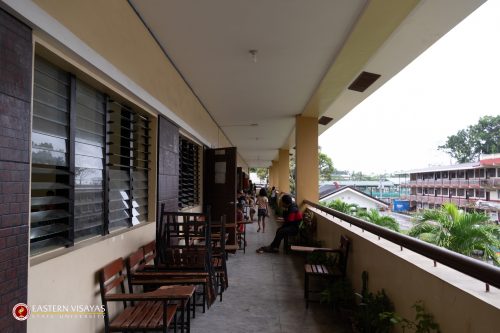
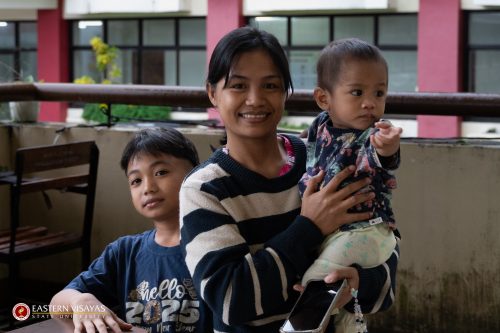
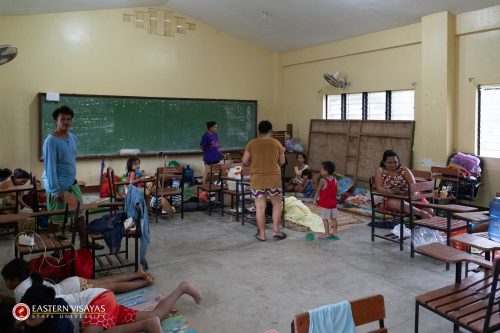
EVSU’s role in supporting displaced communities was further demonstrated during Typhoon Tino in November 2025, when the University accommodated 649 individuals from Barangays 43, 43A, 43B, 44, and 44A, together with EVSU employees and their families who sought refuge on campus. The University’s Disaster Risk Reduction and Management (DRRM) Committee Incident Commander coordinated closely with the City Disaster Risk Reduction and Management Office (CDRRMO) to facilitate evacuation and ensure the proper management of evacuees. Members of the EVSU DRRM Committee were also deployed on site to monitor weather conditions, coordinate with local authorities, and ensure the continuous delivery of assistance. This demonstrates an established university-government coordination mechanism for managing large-scale population displacement during a climate-related emergency.
A similar coordinated response was undertaken during Typhoon Uwan in November 2025, when EVSU provided temporary shelter to more than 150 evacuees, including students, families of university employees, and residents of nearby barangays. The University provided basic necessities such as food, clean water, and sleeping arrangements, while its DRRM Committee worked closely with local government units to monitor the evolving emergency situation. The Committee also oversaw the distribution of essential supplies and ensured that evacuees received medical attention and other necessary support. The response was undertaken while PAGASA had raised Tropical Cyclone Wind Signal No. 2 over Tacloban City and nearby municipalities, demonstrating the University’s responsiveness within the broader government disaster-warning and emergency-management system.
These three 2025 responses demonstrate that EVSU is an active institutional partner in the local disaster-risk reduction and management system, particularly when climate-related hazards require the temporary displacement of communities. The University’s campuses function as additional safe spaces within the local evacuation network, while its DRRM Committee provides an institutional mechanism for coordinating with CDRRMO, LGUs, DSWD, and other authorities. The University’s involvement encompasses not only the provision of physical shelter but also evacuee management, needs assessment, monitoring of hazards, coordination of assistance, medical support, and orderly return of displaced residents.
Taken together, the Typhoon Opong, Tino, and Uwan responses provide concrete evidence of EVSU’s cooperative engagement with government in managing climate-related disaster risks and the displacement of affected populations. These experiences strengthen the University’s capacity to work with government authorities in emergency preparedness, evacuation planning, coordinated response, and community resilience. They also demonstrate EVSU’s institutional commitment to SDG 13 (Climate Action) by translating its DRRM structures and resources into practical support for communities affected by increasingly significant climate and weather-related hazards.
EVSU–Abuyog LGU SMART Disaster Early Warning System: Technology-Enabled Collaboration for Climate Disaster Preparedness, Early Warning, and Community Resilience
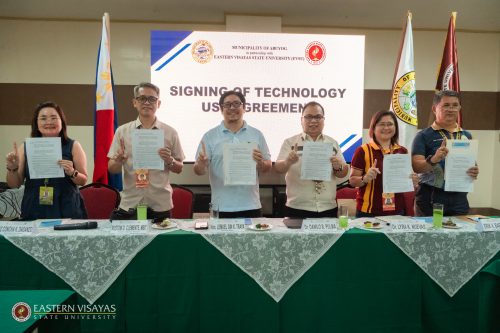
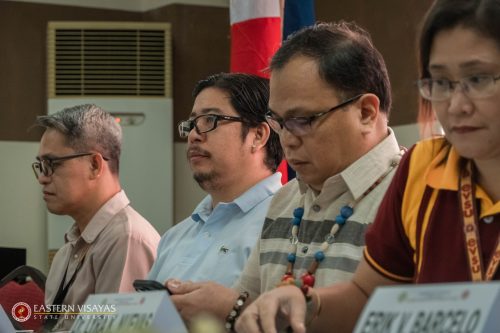
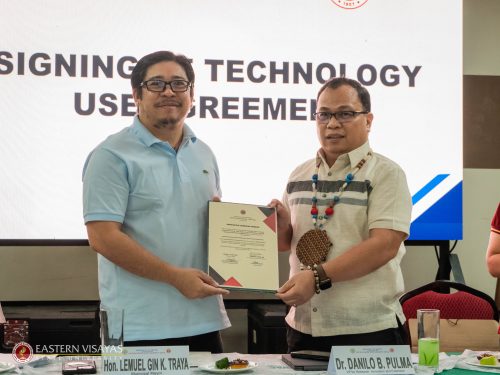
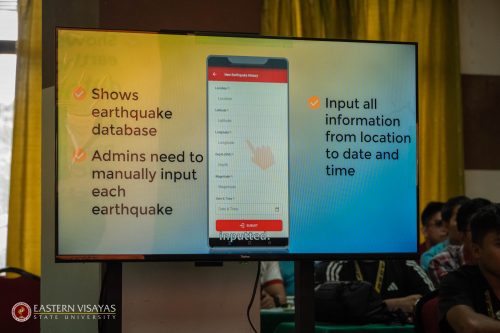
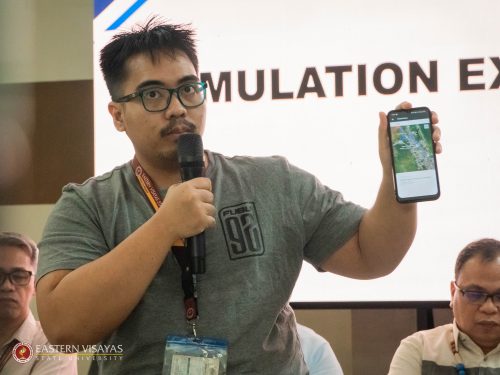
EVSU’s commitment to cooperative disaster preparedness is further demonstrated through its partnership with the Local Government Unit of Abuyog, Leyte, for the development and implementation of the Beeware Application – SMART Disaster Early Warning System (SMART DEWS).
On September 24, 2025, EVSU and the Abuyog LGU formalized their partnership through a Technology Use Agreement for the turnover and utilization of the system. The agreement involved representatives from the University and the local government, including the Municipal Disaster Risk Reduction and Management Office (MDRRMO), which is directly responsible for local disaster preparedness and emergency coordination.
The SMART DEWS was developed to complement the municipality’s existing disaster management initiatives by providing a technology-enabled platform for disseminating early warnings and helping residents make informed decisions during impending emergencies. Its features include GPS-based evacuation routes, evacuation instructions, and notification mechanisms through Android, iOS, and web platforms, as well as SMS and push notifications.
Through location-based information and accessible warning mechanisms, the system helps translate hazard information into actionable guidance for potentially affected residents. It can support community awareness of evacuation routes, timely receipt of warnings, and coordination of preparedness actions before hazards escalate into emergencies.
The collaboration illustrates the complementary responsibilities of EVSU and the local government. EVSU contributes its research, innovation, and technological development capabilities, while the Abuyog LGU and its MDRRMO serve as local government partners in utilizing the system to strengthen community preparedness and disaster management.
Importantly, this initiative connects technological innovation with local-level disaster planning. By supporting early warning and evacuation preparedness, EVSU helps strengthen the ability of local authorities and communities to anticipate climate-related hazards, reduce exposure to risks, and minimize potential displacement and loss of life.
EVSU–Kobe University Disaster Memory Study Program: Multi-Stakeholder Cooperation for Climate Disaster Preparedness, Community Resilience, and Recovery
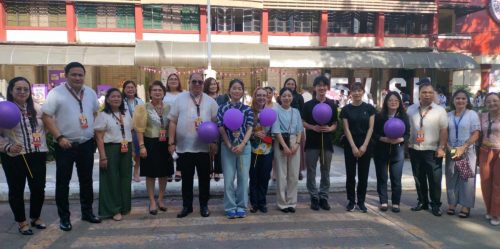
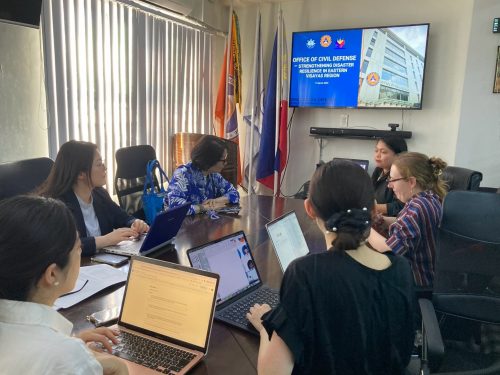
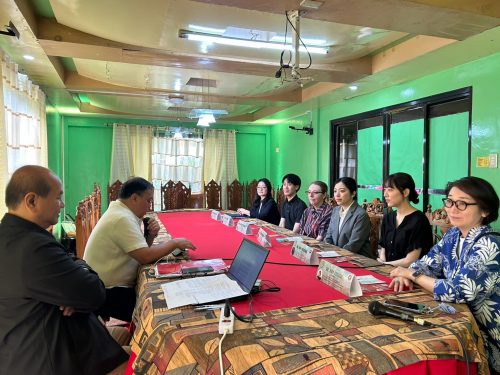
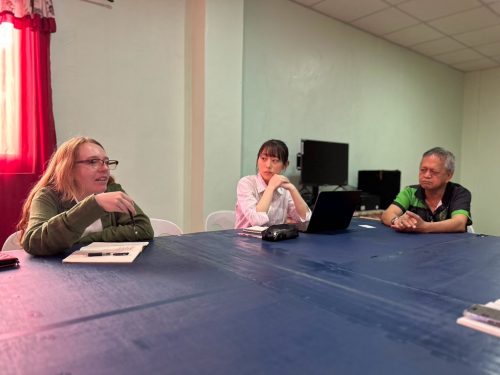
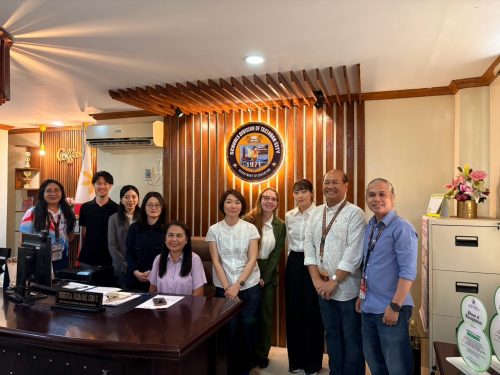
Eastern Visayas State University (EVSU) demonstrates its institutional commitment to cooperative planning and disaster resilience through its collaboration with international academic institutions, government agencies, local communities, and disaster-affected stakeholders. A notable example is the Disaster Memory Study Program conducted in Tacloban City from March 10–18, 2025, in partnership with Kobe University’s Graduate School for International Cooperation Studies (GSICS), Japan. The program examined how disaster experiences are preserved, communicated across generations, and translated into improved disaster preparedness, response, recovery, and community resilience.
The initiative focused on Tacloban City and nearby municipalities severely affected by Super Typhoon Haiyan (Yolanda), recognizing that climate-related disasters can result not only in loss of lives and infrastructure but also in long-term displacement, disruption of communities, and challenges to recovery and resettlement. Through EVSU’s institutional coordination, the Kobe University delegation engaged with government agencies and public institutions, including the Philippine Atmospheric, Geophysical and Astronomical Services Administration (PAGASA), the Department of Education (DepEd), and the Office of Civil Defense, as well as local communities, coastal barangays, academic and religious institutions, and disaster memorial sites.
This multi-stakeholder engagement provided a platform for sharing government, academic, and community perspectives on disaster risk reduction and management. Importantly, the study incorporated first-hand accounts from disaster survivors and local communities, enabling the participants to understand the long-term social consequences of disasters and the strategies communities use to rebuild and strengthen resilience. The resulting knowledge contributes to improving disaster preparedness and response planning and provides lessons that can be applied both locally and internationally, particularly between the Philippines and Japan, two countries highly exposed to climate and natural hazards.
The activity therefore illustrates EVSU’s role as an institutional partner in cooperative disaster planning, rather than limiting disaster-related engagement to emergency response. By connecting international research, government disaster-management institutions, local governments and communities, and academic expertise, EVSU facilitates the exchange of knowledge needed to anticipate and address the broader consequences of climate-related disasters, including community displacement and long-term recovery.
Furthermore, the activity supports EVSU’s broader institutional direction of using education, research, internationalization, and stakeholder partnerships to address global and regional challenges. EVSU and Kobe University expressed the intention to build on the initiative through further collaborative research on disaster education and policy development.
EVSU–La Trobe University Research Collaboration: Participatory Research on Climate Change, Human Security, and Community Resilience
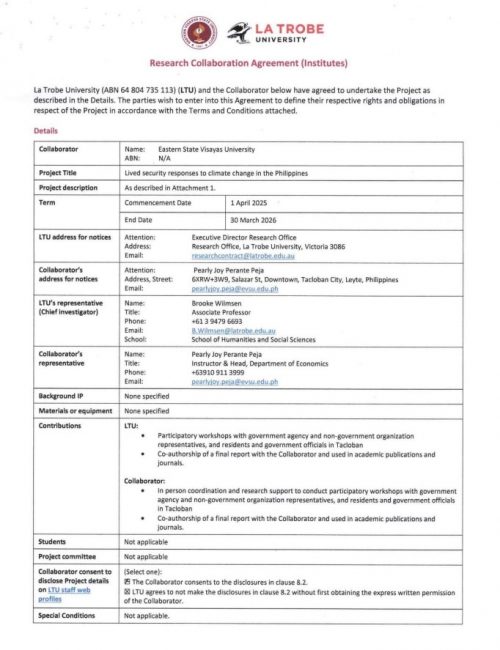
Recognizing that climate-related disasters have implications beyond immediate physical damage, Eastern Visayas State University (EVSU) actively participates in collaborative research and multi-stakeholder engagements that examine the broader implications of climate change for human security, community vulnerability, displacement, and climate adaptation planning. These efforts recognize that effective climate-disaster management requires not only infrastructure development and emergency response mechanisms but also an understanding of how government interventions affect people’s everyday lives, livelihoods, security, and access to safe and sustainable communities.
A significant manifestation of this commitment is EVSU’s participation in the international research collaboration entitled Lived Security Responses to Climate Change in the Philippines, in partnership with La Trobe University, Australia. Covered by a Research Collaboration Agreement effective April 1, 2025, to March 30, 2026, the project brings together academic institutions and research partners from the Philippines and overseas, including the Center for Climate Change and Environmental Research (CCARPH), Ateneo de Manila University, EVSU, Visayas State University (VSU), Lingnan University, and the University of Melbourne. The collaboration seeks to strengthen institutional research relationships, generate interdisciplinary knowledge, and develop a more comprehensive understanding of how Philippine coastal communities respond to climate change and government-led adaptation interventions.
The initiative recognizes that climate change can affect human security through livelihood disruption, environmental degradation, resource insecurity, displacement, and increased vulnerability among communities exposed to climate-related hazards. Understanding these interconnected concerns requires the participation of affected communities, government institutions, and other development stakeholders.
Under the collaboration, EVSU committed to providing in-person coordination and research support for participatory workshops involving government agency representatives, non-government organizations, local residents, and government officials in Tacloban City. These engagements provide opportunities for community members and institutional stakeholders to share experiences, identify climate-related security concerns, and contribute perspectives that can inform research and policy discussions.
Through this partnership, EVSU expands its contribution to climate resilience by supporting evidence-based understanding of how communities experience and respond to climate-related challenges. The participatory approach also recognizes the importance of incorporating local knowledge and the perspectives of affected populations into the development of appropriate climate adaptation and disaster risk reduction interventions.
While this research collaboration is primarily an evidence-generation and participatory research initiative rather than a formal displacement contingency plan, it complements the University’s operational disaster preparedness efforts by addressing the broader social and human-security dimensions of climate change.
Institutional Commitment to Strengthening Climate Resilience and Cooperative Disaster Management
Collectively, EVSU’s 2025 initiatives demonstrate a multi-dimensional institutional contribution to cooperative planning and action for climate-related disasters. The University’s engagement encompasses the entire continuum of disaster risk reduction and management: collaborative risk discussions and mitigation planning, development of technological solutions, strengthening of local government capacities, early warning and evacuation preparedness, emergency coordination, and assistance to disaster-displaced populations.Through its engagement with the Climate Change Commission, DOST, DENR, DPWH, DSWD, Tacloban City Government, Abuyog LGU, municipal disaster management councils, and other community stakeholders, EVSU demonstrates its commitment to working with government institutions in addressing climate-related vulnerabilities at the local and regional levels.
These partnerships reflect the University’s understanding that effective climate-disaster management cannot be achieved through isolated institutional interventions. It requires sustained cooperation among government agencies, academic institutions, local authorities, civil society organizations, and affected communities. EVSU therefore contributes not only as an educational institution but also as a research and innovation partner, technical resource institution, extension service provider, and community support institution.
The University’s initiatives are particularly relevant to Eastern Visayas, where communities face recurring exposure to typhoons, flooding, and other climate-related hazards that can result in temporary displacement, disruption of livelihoods, and increased demand for emergency shelter and social protection services. By supporting collaborative preparedness mechanisms, improving access to early-warning information, strengthening local emergency response capabilities, and making campus facilities available to displaced residents, EVSU helps strengthen the capacity of communities and local governments to anticipate, prepare for, respond to, and recover from climate-related disasters.
These efforts are aligned with EVSU’s institutional vision of becoming the National University for Resiliency and Climate Action by 2040. Through sustained partnerships, research-driven innovations, community engagement, and coordinated disaster risk reduction initiatives, the University continues to advance its role as an active development partner in building safer, more prepared, and climate-resilient communities throughout Eastern Visayas.
EXPLORE OUR SDG 13 INITIATIVES & ACTIVITIES
EXPLORE OUR SDG 13 RESEARCH & PUBLICATIONS
SUSTAINABLE DEVELOPMENT GOALS