
SDG 7 | AFFORDABLE AND CLEAN ENERGY

University Energy Efficiency Standards

Eastern Visayas State University (EVSU) recognizes energy efficiency and sustainable infrastructure development as essential components of its institutional commitment to environmental sustainability, responsible resource management, and climate resilience. In pursuing its mandate as a state university, EVSU acknowledges that the planning, design, construction, renovation, retrofitting, and operation of campus buildings and physical facilities have significant implications for energy consumption, operational costs, greenhouse gas emissions, and the University’s overall environmental footprint. Accordingly, the University endeavors to embed energy efficiency and conservation principles throughout the entire infrastructure development and facilities management cycle, ensuring that sustainability considerations are incorporated not only in the construction of new buildings but also in the improvement, modernization, and continued operation of existing facilities across its campuses.

This institutional commitment is reflected in the University’s adoption of policies, administrative mechanisms, technical requirements, and infrastructure development practices that promote energy-efficient building designs, the integration of renewable energy technologies, and the responsible utilization of electricity and other energy resources. These measures encompass the promotion of natural lighting and ventilation, energy-efficient lighting and electrical systems, high-efficiency cooling equipment, improved building envelope performance, smart energy controls, and the consideration of solar, wind, and other appropriate clean energy technologies. By incorporating these principles into infrastructure planning and project specifications, EVSU seeks to reduce unnecessary energy consumption, improve building performance, optimize the use of public resources, and provide safe, comfortable, and environmentally responsible spaces for teaching, learning, research, extension, and administrative operations.
Institutional Policy and Governance Framework

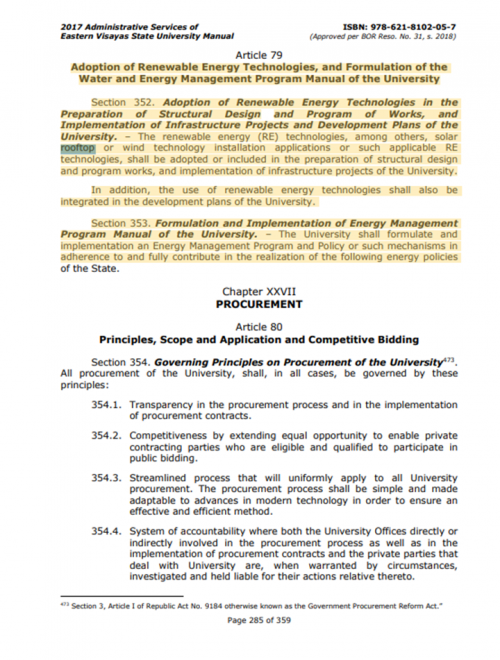
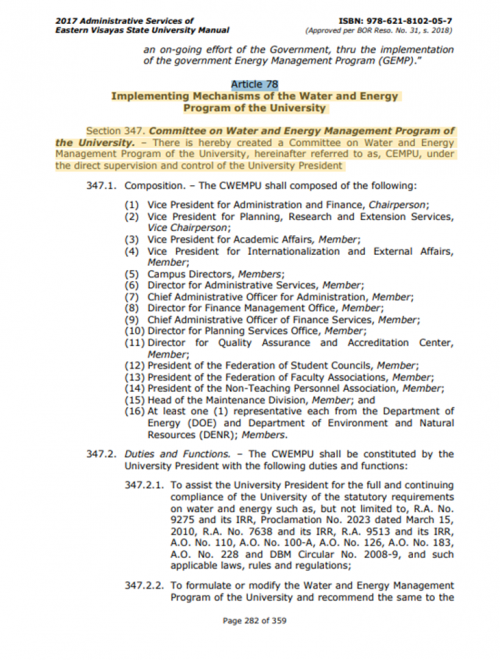
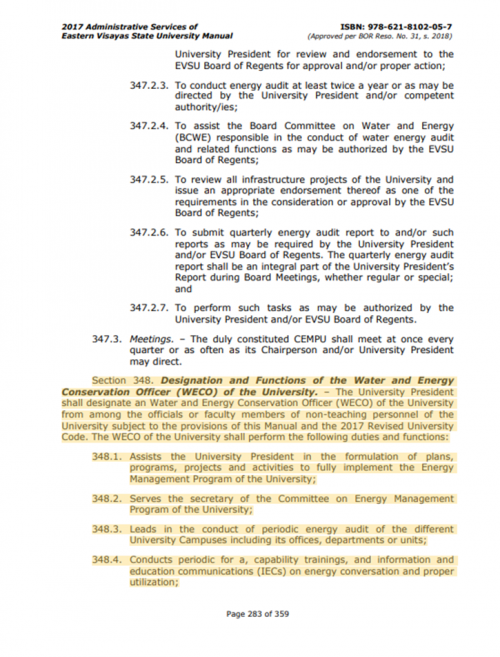
The University’s institutional commitment is anchored in its 2017 EVSU Administrative Services Manual, particularly Article 78, which establishes the University’s Water and Energy Management Program, and Article 79, which provides for the adoption of renewable energy technologies. Under Article 78, the University institutionalizes an administrative structure for managing and monitoring energy consumption through the Committee on Water and Energy Management Program and the designation of a Water and Energy Conservation Officer (WECO). Among the responsibilities established under this framework are the coordination of energy conservation initiatives, periodic energy audits across University campuses, and the recommendation of energy-efficient equipment and facilities. The corresponding Board Committee on Water and Energy provides an additional governance and oversight mechanism for the University’s energy management policies, plans, and programs.

More specifically, Article 79, Section 352, of the Administrative Services Manual, approved under Board Resolution No. 31, s. 2018, provides for the integration of renewable energy technologies, including rooftop solar and wind energy applications, into the preparation of structural designs, programs of work, infrastructure projects, and University development plans. This provision establishes an institutional policy basis for incorporating energy considerations and renewable energy solutions into campus infrastructure planning and development, rather than treating energy conservation solely as an operational concern.

This commitment is further reinforced by EVSU’s SDG 7: Affordable and Clean Energy Policy, which promotes energy efficiency and conservation through smart building designs, energy-efficient appliances, renewable energy solutions, and energy-conscious practices within the University. Complementarily, the University’s SDG 11: Sustainable Cities and Communities Policy supports the development of climate-resilient and environmentally sustainable campuses through green building standards, resource-efficient infrastructure, and sustainable campus development initiatives. Together, these institutional policies provide the sustainability framework for integrating energy efficiency into the University’s physical infrastructure and institutional operations.
Compliance with National Energy Efficiency and Green Building Legislation

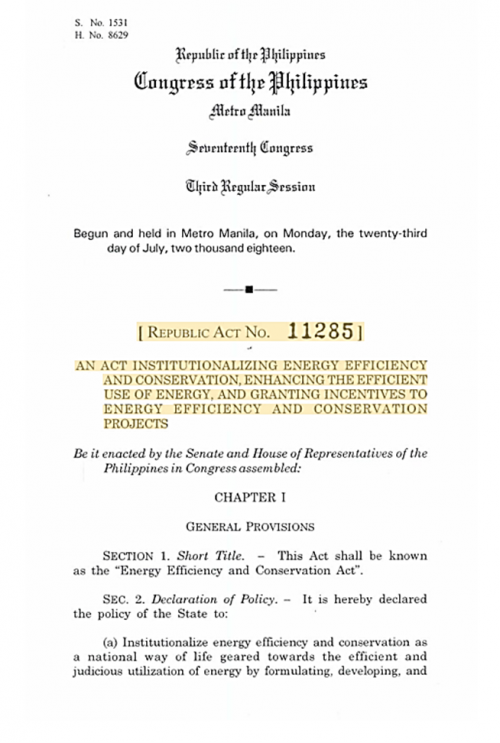
EVSU’s infrastructure development initiatives are guided by Republic Act No. 11285, or the Energy Efficiency and Conservation Act of 2019, which institutionalizes energy efficiency and conservation as a national policy and promotes the efficient utilization of energy resources. Of particular relevance is Section 18 of the Act, which expressly addresses energy performance in both new and existing buildings. It requires new building construction to comply with the minimum requirements under the Department of Energy (DOE) Guidelines on Energy Conserving Design of Buildings. It likewise requires building retrofits to comply with the applicable minimum energy-efficiency requirements. The provision specifically covers educational facilities and government buildings, making it directly relevant to the University’s infrastructure development and improvement activities.

Furthermore, Section 18 establishes that state-owned buildings and facilities must comply with the Government Energy Management Program (GEMP) and applicable guidelines issued by the Inter-Agency Energy Efficiency and Conservation Committee (IAEECC). This provides an important national regulatory basis for EVSU to incorporate energy-efficiency requirements not only in new construction but also in renovations, retrofitting, and improvements to existing University facilities.

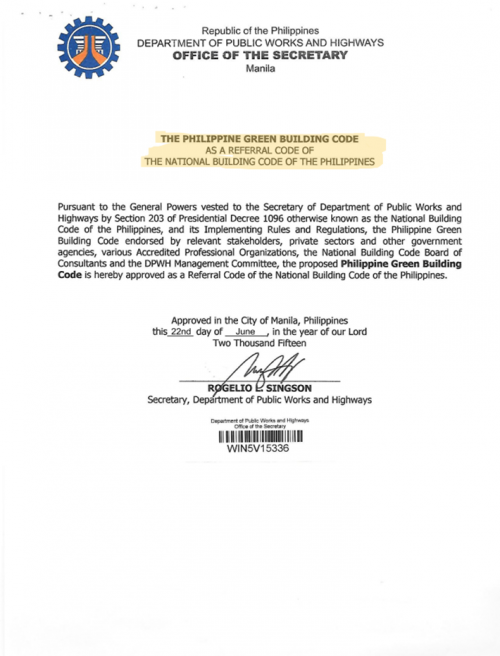
The University’s infrastructure planning also recognizes the principles embodied in the Philippine Green Building Code, which promotes the development of resource-efficient and environmentally responsible buildings. The Code provides technical requirements and guidelines covering energy efficiency, water efficiency, sustainable site development, materials sustainability, and indoor environmental quality. Its application supports the integration of green building principles into architectural and engineering design, construction, and building improvements.

In addition, Section 37 of Republic Act No. 10964, or the General Appropriations Act of 2018, provides guiding principles for sustainable and resilient government buildings and facilities. It directs the Department of Public Works and Highways (DPWH) to consider climate data, risk assessments, and green building standards in the planning, designing, construction, engineering, and renovation of government buildings and facilities. This reinforces the national government’s commitment to ensuring that public infrastructure investments incorporate environmental sustainability and climate resilience considerations.

EVSU also considers the requirements of the National Building Code of the Philippines (Presidential Decree No. 1096), the Philippine Electrical Code, applicable mechanical engineering standards, and the DOE’s 2020 Guidelines on Energy Conserving Design of Buildings. These regulations and technical references provide the framework for incorporating energy-efficient architectural, electrical, mechanical, and building systems into University infrastructure projects.

Application of Energy-Efficient Standards in New Construction and Infrastructure Projects

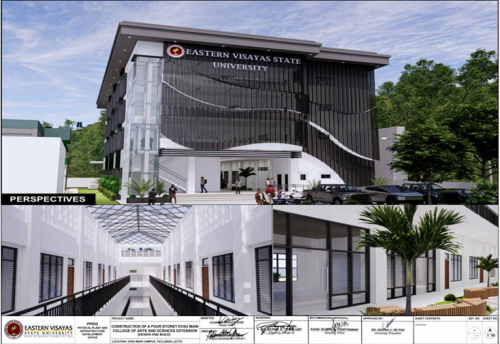
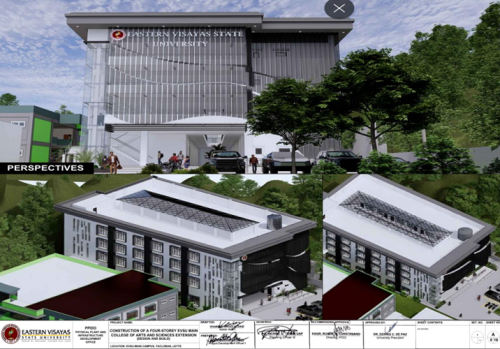
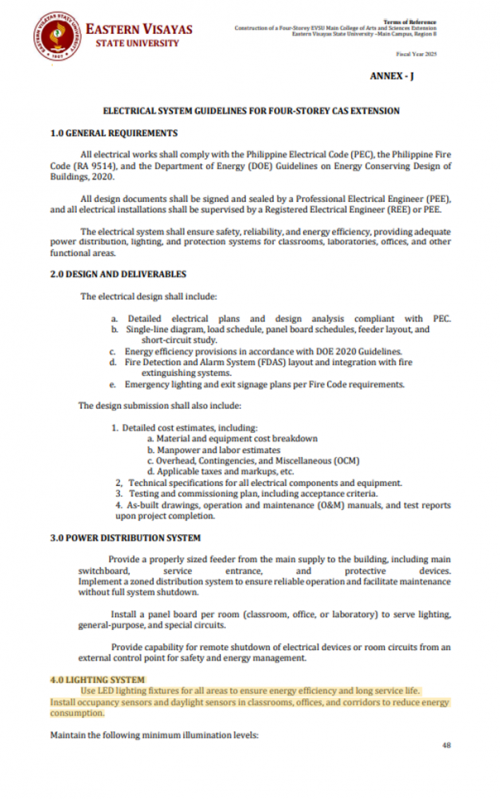
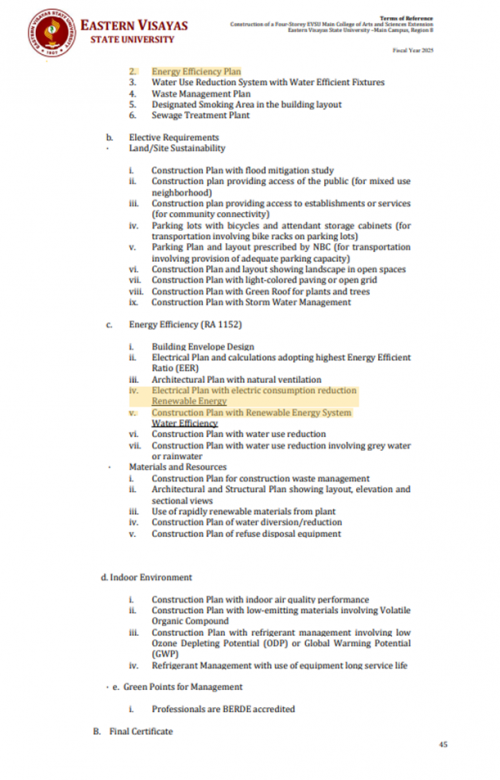
The University’s commitment is demonstrated through the actual technical requirements incorporated into its infrastructure procurement and project implementation documents. A notable example is the FY 2025 Terms of Reference (TOR) for the Construction of the Four-Storey College of Arts and Sciences Extension Building at the EVSU Main Campus. The project explicitly requires the preparation of an Energy Efficiency Plan and incorporates energy-conservation considerations into its architectural, electrical, mechanical, and electronics engineering design requirements.

Among the prescribed measures are energy-efficient building envelope designs, natural ventilation, high Energy Efficiency Ratio (EER) requirements for cooling systems, and electrical designs that promote reduced electricity consumption. The project specifications also incorporate renewable energy system provisions, LED lighting fixtures, occupancy and daylight sensors for classrooms, offices, and corridors, and remote shutdown capabilities for electrical devices or room circuits. These measures are intended to optimize energy performance, minimize unnecessary electricity consumption, and improve the operational efficiency of the building throughout its service life.

The project further demonstrates EVSU’s effort to incorporate broader green building principles into infrastructure development. Its technical requirements include provisions relating to water efficiency, indoor environmental quality, and waste management, while also requiring an Energy Efficiency Plan as part of the preliminary Green Building Certificate requirements. The TOR also recognizes the relevance of BERDE-accredited professionals in supporting green building management and assessment. This reflects the University’s recognition that energy efficiency should form part of an integrated sustainable building approach encompassing environmental performance, occupant comfort, resource conservation, and operational sustainability.

Commitment to Sustainable and Climate-Resilient Campus Infrastructure

Through the integration of energy-efficiency considerations into its administrative policies, sustainability commitments, infrastructure planning processes, and project-specific technical specifications, EVSU demonstrates an institutional approach to promoting sustainable building development. Its policies and project requirements reinforce the application of energy-efficient design principles, renewable energy technologies, and applicable national building and energy conservation standards in the development and improvement of University facilities.

Ultimately, EVSU seeks to ensure that its infrastructure investments contribute not only to the provision of adequate and functional learning, research, and administrative spaces but also to the University’s long-term sustainability objectives. By embedding energy efficiency into campus development and facility management, the University strengthens its contribution to responsible energy consumption, climate change mitigation, resource conservation, and the development of environmentally sustainable and climate-resilient campuses.

EXPLORE OUR SDG 7 INITIATIVES & ACTIVITIESS

2026202520242023
SDG 7: Initiatives for 2026
SDG 7: Initiatives for 2025
SDG 7: Initiatives for 2024
SDG 7: Initiatives for 2023

EXPLORE OUR SDG 7 RESEARCH & PUBLICATIONS

202520242023
SDG 7: Publications for 2025
SDG 7: Publications for 2024
SDG 7: Publications for 2023

SUSTAINABLE DEVELOPMENT GOALS

20252024
2025: Sustainable Development Goals
2024: Sustainable Development Goals