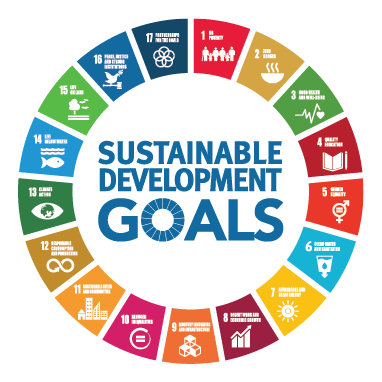
Eastern Visayas State University (EVSU) continues to advance its vision as a transformative institution in 2025, steadfast in its commitment not only to excellence in instruction, research, and extension, but also to shaping a resilient, inclusive, and sustainable future. Anchored on its aspiration to become the National University for Resiliency and Climate Action, EVSU upholds sustainability as both a strategic priority and a shared responsibility across all sectors of the university.
Guided by the principles of the United Nations’ 2030 Agenda for Sustainable Development, EVSU further strengthens the integration of the Sustainable Development Goals (SDGs) into its core functions. In 2025, the University deepens its SDG alignment by embedding sustainability-driven approaches in academic programs, expanding interdisciplinary research on climate and community resilience, and enhancing partnerships that address both local and global challenges. These efforts ensure that sustainability is not treated as a standalone agenda, but as a unifying framework that informs decision-making, innovation, and impact.
Building on the foundations established in previous years, EVSU continues to enhance its sustainability governance by promoting inclusive education, advancing health and well-being initiatives, strengthening environmental stewardship, supporting sustainable livelihoods, and fostering strong institutional collaborations. Through a whole-of-university approach, every initiative—whether in the classroom, in research laboratories, in communities, or within campus operations—contributes to the realization of the SDGs and the broader goal of sustainable development.
This 2025 report captures the collective efforts of the EVSU community—its students, faculty, staff, and partners—whose dedication drives meaningful and measurable change. It reflects the University’s enduring commitment to responsible leadership, ethical governance, and transformative action as it continues to serve as a catalyst for sustainable development in Eastern Visayas and beyond.
SDG 12: Responsible Consumption and Production – EVSU 2025 Initiatives
Eastern Visayas State University (EVSU) recognizes that responsible consumption and production are essential to achieving environmental sustainability and building a resource-efficient institution. As a public higher education institution, EVSU acknowledges its responsibility to minimize the environmental impact of its operations by promoting sustainable resource utilization, waste reduction, proper waste management, recycling, and environmentally responsible procurement and consumption practices. Through its institutional policies, academic programs, research, extension services, and partnerships with government agencies and local communities, the University seeks to cultivate a culture of environmental responsibility among its students, faculty, staff, and stakeholders. These efforts reflect EVSU’s commitment to advancing Sustainable Development Goal 12 (Responsible Consumption and Production) by integrating sustainability principles into campus operations and extending responsible environmental practices beyond the University.
In 2025, Eastern Visayas State University (EVSU) advanced responsible consumption and production through initiatives that promoted sustainable waste management, resource conservation, environmental awareness, and responsible enterprise development. Recognizing the importance of reducing waste and using resources efficiently, the University engaged its students, personnel, local government partners, and community stakeholders in activities that encouraged practical environmental responsibility both within the institution and in surrounding communities.
A key initiative was the Sustainable Solid Waste Management Forum, held on February 12, 2025, at Tacloban City Hall in collaboration with the Tacloban City Government. With the theme “Leading the Way: Barangay Chairpersons and the Quest for Sustainable Waste Management,” the forum brought together barangay officials, representatives of the Environmental Management Bureau (EMB) Region VIII, the City Environment and Natural Resources Office (CENRO), and other stakeholders. Discussions focused on the implementation of Republic Act No. 9003, or the Ecological Solid Waste Management Act of 2000, including waste segregation, proper disposal, local environmental regulations, and the responsibilities of barangay leaders in promoting sustainable waste practices. Through this engagement, EVSU helped strengthen local capacity and collaboration for more effective community-based waste management.
At the campus level, EVSU strengthened waste-management practices through the Waste Management Orientation conducted on March 4, 2025, by the Department of Natural Sciences and the Pollution Control Office. The activity equipped maintenance personnel with practical knowledge of proper waste handling and disposal in accordance with RA 9003, reinforcing the importance of integrating environmentally responsible practices into the University’s daily operations. This was complemented by a Waste Analysis and Characterization Study (WACS) Orientation on November 15, 2025, for National Service Training Program–Civic Welfare Training Service (NSTP-CWTS) students. The orientation introduced waste classification, segregation, reduction, reuse, recycling, and proper disposal, while emphasizing the role of waste characterization in developing effective management strategies.
The University also moved from awareness-building toward evidence-based waste management through the WACS implementation on November 22, 2025, at the EVSU Main Campus. Organized by the Pollution Control Office in partnership with the Society of Environmental Science Students, the activity involved NSTP-CWTS students in sorting, identifying, and weighing collected waste. The assessment aimed to establish baseline information on the University’s waste-generation patterns, which can guide monitoring, identify opportunities to reduce waste, and inform improvements in campus waste-management practices.
EVSU further reinforced environmental stewardship through its partnership with the Department of Environment and Natural Resources (DENR) in a tree-planting activity and a waste-management seminar for university personnel on December 17, 2025. The seminar discussed waste segregation, reduction, and responsible disposal, complementing the University’s efforts to promote environmental responsibility among its employees. Together, these activities emphasized that responsible consumption and production require not only institutional policies and facilities but also the active participation of students and personnel in everyday resource-use and waste-management decisions.
These initiatives are guided by EVSU’s SDG 12 institutional policy, which is anchored in the Ecological Solid Waste Management Act of 2000 (Republic Act No. 9003), the Extended Producer Responsibility Act of 2022 (Republic Act No. 11898), and the Philippine Environment Code (Presidential Decree No. 1152). The policy commits the University to institutionalizing waste segregation, reducing single-use plastics, promoting recycling, composting and upcycling, adopting sustainable procurement practices, and improving the efficient use of water, energy, paper, and other resources. It also emphasizes integrating responsible consumption and production into academic programs, research, extension activities, and partnerships with government, industry, and communities. Overall, EVSU’s 2025 initiatives demonstrate its efforts to cultivate a culture of sustainability through environmental education, campus waste assessment, personnel capacity-building, and collaboration with local stakeholders. These efforts provide a foundation for more systematic waste reduction and resource efficiency across the University and its partner communities.
SDG 12 in Action: EVSU’s 2025 Responsible Consumption and Production Initiatives
Through its holistic approach to sustainability, Eastern Visayas State University (EVSU) demonstrates that each initiative—whether in health, education, economic development, or collaborative partnerships—contributes to a larger, integrated vision of progress aligned with the United Nations’ 2030 Agenda. By embedding the principles of the Sustainable Development Goals across research, teaching, extension, and governance, EVSU not only addresses immediate regional and national challenges but also equips future leaders to innovate responsibly, act ethically, and advocate for inclusive growth.
As EVSU moves forward, the university remains committed to tracking measurable outcomes, strengthening stakeholder engagement, and fostering transformative partnerships that accelerate the attainment of all 17 SDGs. This report reflects EVSU’s unwavering dedication to building a resilient, equitable, and sustainable future—demonstrating that collective action, guided by knowledge and ethical stewardship, can truly make a lasting impact for generations to come.