SDG 17 | PARTNERSHIP FOR THE GOALS

Cross Sectoral Dialogue About SDGs

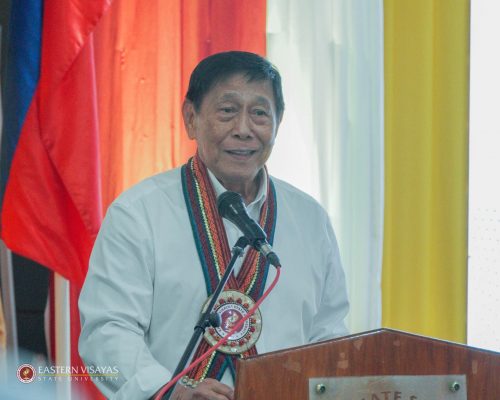
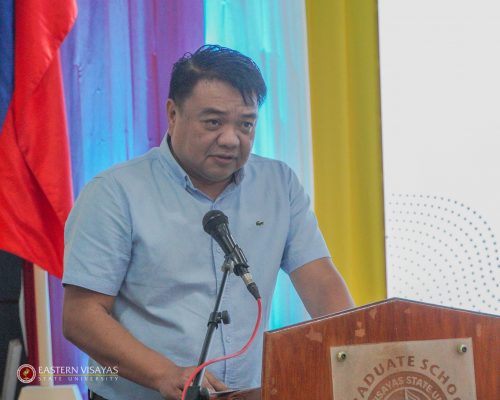
Eastern Visayas State University (EVSU) recognizes that achieving the Sustainable Development Goals (SDGs) requires collective commitment, inclusive participation, and sustained collaboration among sectors of society. As a state university with a strong commitment to regional and national development, EVSU actively initiates, facilitates, and participates in cross-sectoral dialogues that bring together government agencies, local government units, nongovernment organizations (NGOs), civil society organizations, private enterprises, academic institutions, international development partners, and local communities. Through conferences, stakeholder consultations, policy-oriented forums, industry engagements, and international academic platforms, the University provides opportunities for diverse stakeholders to exchange knowledge, identify pressing development challenges, discuss policy directions, and formulate collaborative approaches to sustainability concerns.

Throughout 2025, EVSU strengthened its role as a catalyst for meaningful dialogue by convening and engaging stakeholders on critical issues such as environmental protection, sustainable waste management, climate change adaptation, disaster resilience, inclusive education, poverty alleviation, food security, technological innovation, and regional economic development. From facilitating discussions with government agencies and barangay leaders to participating in national sustainable development conferences and serving as the Visayas Regional Hub for the European Higher Education Fair 2025, the University demonstrated its commitment to connecting local priorities with national and international development agendas.

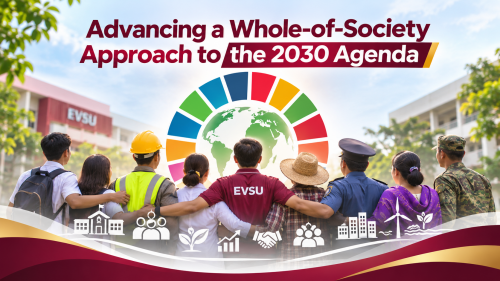
These engagements underscore EVSU’s recognition that sustainable development cannot be achieved through isolated institutional efforts. By fostering partnerships, encouraging multi-stakeholder participation, and bridging academic expertise with government policy, industry innovation, civil society perspectives, and community needs, EVSU advances a whole-of-society approach to the 2030 SDG Agenda.

Strengthening Cross-Sectoral Dialogue and Collaborative Action
for the Sustainable Development Goals

Eastern Visayas State University (EVSU) recognizes that the achievement of the United Nations Sustainable Development Goals (SDGs) requires more than institutional commitments and individual interventions. It necessitates sustained collaboration, meaningful engagement, and open dialogue among government institutions, nongovernment organizations (NGOs), civil society organizations (CSOs), private enterprises, academic institutions, development partners, and local communities. As a state university with a mandate to contribute to regional and national development, EVSU actively assumes the role of both a convener and participant in cross-sectoral dialogues, providing platforms where diverse stakeholders can exchange knowledge, articulate development concerns, examine emerging challenges, and identify collective strategies toward sustainable and inclusive development.

Throughout 2025, the University demonstrated this commitment through the organization and participation in conferences, stakeholder consultations, policy-oriented forums, and collaborative engagements addressing interconnected concerns in environmental protection, climate change adaptation, disaster resilience, education, poverty alleviation, food security, technological innovation, and regional economic development. These initiatives reflect EVSU’s recognition that complex sustainability challenges cannot be addressed by any single institution or sector. Instead, they require the integration of scientific knowledge, government policies, private-sector capabilities, civil society participation, and community-based perspectives.
Convening Government and Community Stakeholders for Environmental Sustainability and Localized SDG Action

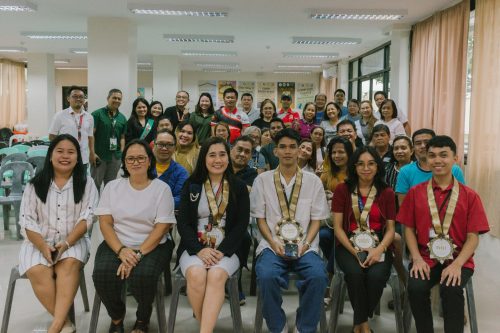
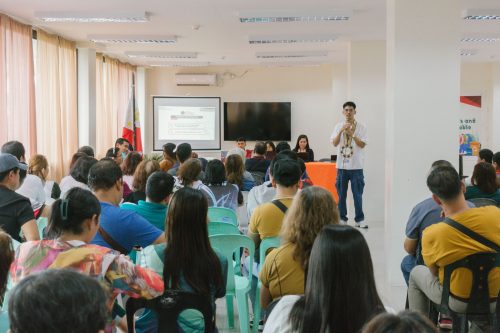
One of EVSU’s significant contributions to cross-sectoral dialogue in 2025 was its organization of the Sustainable Waste Management Forum, held on February 12, 2025, at Tacloban City Hall, in collaboration with the Tacloban City Government. With the theme Leading the Way: Barangay Chairpersons and the Quest for Sustainable Waste Management, the forum brought together barangay chairpersons and representatives from the Environmental Management Bureau (EMB) Region VIII, the City Environment and Natural Resources Office (CENRO), and local government institutions to discuss the challenges and responsibilities associated with implementing sustainable waste management practices at the community level.

The discussions centered on the implementation of Republic Act No. 9003, or the Ecological Solid Waste Management Act of 2000, and the importance of strengthening local environmental governance, improving waste segregation and disposal practices, and encouraging active participation among barangays and their constituents. By bringing together environmental regulators, local government officials, academic stakeholders, and grassroots community leaders, EVSU helped bridge the gap between national environmental legislation and its practical implementation within local communities.

This initiative illustrates the University’s contribution to localized SDG dialogue by providing an avenue for stakeholders to discuss environmental governance challenges, share institutional perspectives, and reinforce collective accountability for sustainable communities. It supports SDG 11 (Sustainable Cities and Communities), SDG 12 (Responsible Consumption and Production), SDG 13 (Climate Action), and SDG 17 (Partnerships for the Goals).

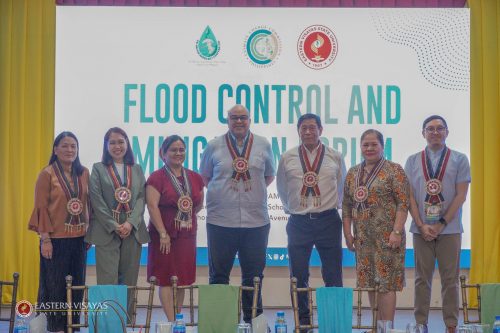
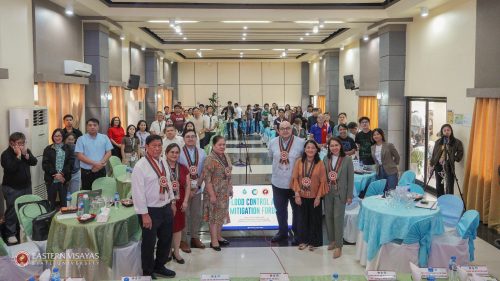
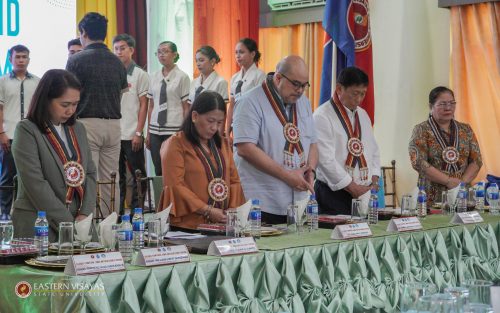
Complementing its environmental sustainability initiatives, EVSU also convened the Flood Control and Mitigation Forum: Building Resilience Together on March 7, 2025, at the EVSU Graduate School Function Hall. Organized in collaboration with PH Haiyan, the forum brought together representatives from the Climate Change Commission, Tacloban City Government, Department of Environment and Natural Resources (DENR) Region VIII, Department of Public Works and Highways (DPWH) Region VIII, private-sector organizations, civil society representatives, and community stakeholders.

Among the resource persons and participants were Climate Change Commission Deputy Executive Director Atty. Romell Antonio O. Cuenca, PH Haiyan Chairman Petronilo Ilagan, representatives from the Tacloban City Planning Office, Robinsons Tacloban, and the Tacloban Federation of Senior Citizens. Their participation enabled discussions to incorporate perspectives from climate policy institutions, infrastructure and environmental agencies, local development planners, private enterprises, and vulnerable community sectors.

The forum addressed Tacloban City’s flood vulnerabilities and the importance of coordinated approaches to flood mitigation, climate change adaptation, disaster risk reduction, and resilient urban development. Discussions also provided an opportunity to examine national climate policy directions, including the National Adaptation Plan, in relation to the specific environmental and development concerns of Eastern Visayas. By facilitating dialogue among institutions with different mandates and areas of expertise, EVSU contributed to a more integrated understanding of climate-related risks and the need for science-based, inclusive, and coordinated responses.

The participation of community organizations, including the Federation of Senior Citizens, further highlighted the importance of considering the concerns of vulnerable populations in disaster preparedness and resilience planning. This demonstrates EVSU’s commitment to promoting cross-sectoral and inclusive dialogue that connects national policy directions with regional realities and community priorities. The initiative directly advances SDG 11, SDG 13, and SDG 17.

Facilitating Academia-Government-Industry Dialogue for Inclusive Education and Workforce Development

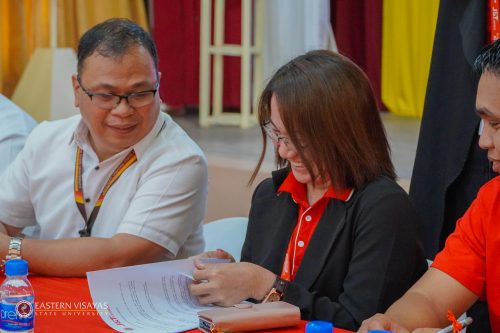
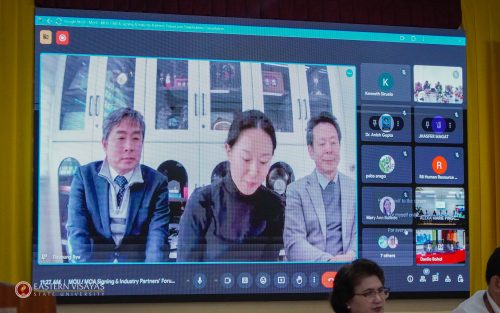
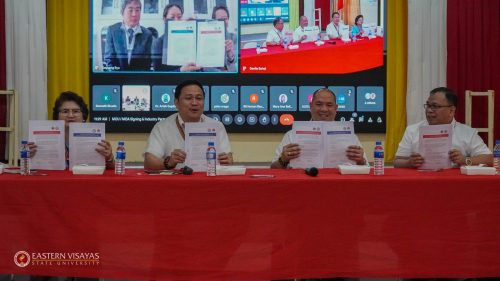
Recognizing the importance of aligning higher education with societal and economic development priorities, EVSU also organized an Industry Partner Forum and Stakeholders’ Consultation on February 18, 2025, as part of its 118th Founding Anniversary celebration. Organized through the University’s Office of Internationalization and External Affairs, the activity provided a platform for university officials, industry representatives, government education stakeholders, and institutional partners to discuss opportunities for strengthening collaboration between higher education and the sectors it serves.

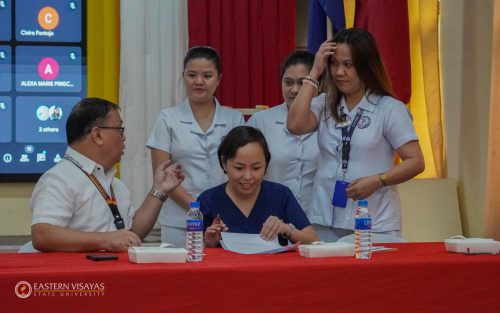
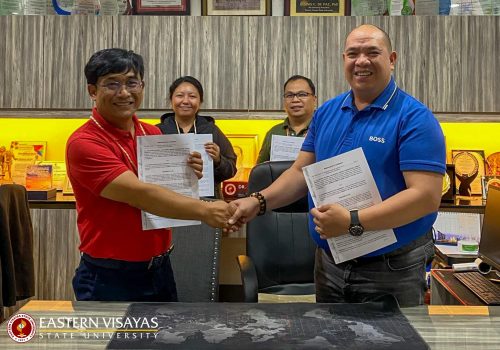
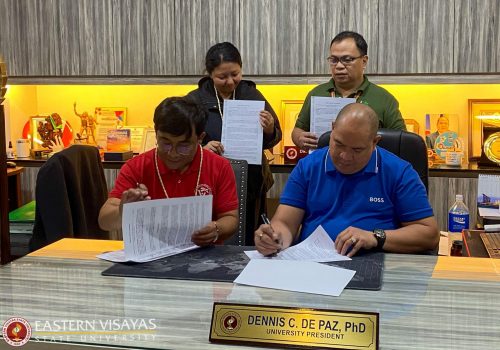
The consultation complemented the University’s partnership-building activities, including the signing of memoranda of agreement and understanding with local and international partners. More importantly, it created an avenue for stakeholders to exchange perspectives on how academic programs, institutional capabilities, and external partnerships can respond more effectively to emerging workforce requirements and community development needs.

A notable contribution came from Education Program Supervisor Maria Joy A. Arias, representing the Department of Education, who discussed the importance of strengthening academia-industry collaboration and ensuring that educational opportunities respond to the needs of diverse learners, particularly Alternative Learning System (ALS) learners, out-of-school youth, and adult learners.

Through this engagement, EVSU reinforced the importance of connecting educational institutions, government agencies, and industry stakeholders in addressing gaps in educational access, skills development, employability, and workforce preparedness. It demonstrated how institutional consultations can serve as mechanisms for identifying shared concerns, aligning development priorities, and developing collaborative approaches to inclusive education and decent work.

The initiative supports SDG 4 (Quality Education), SDG 8 (Decent Work and Economic Growth), and SDG 17 (Partnerships for the Goals).

Promoting Research, Innovation, and Multi-Stakeholder Dialogue for Regional Food Security and Economic Development

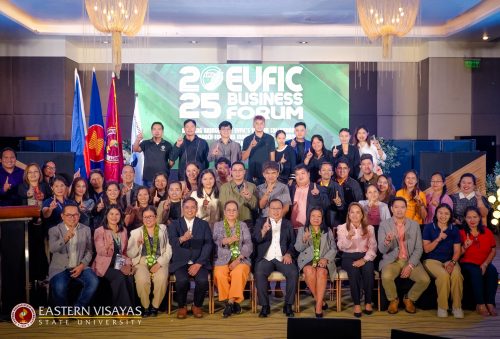
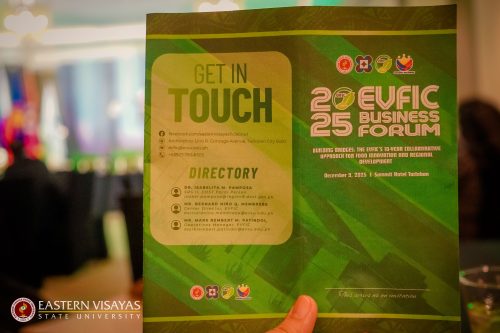
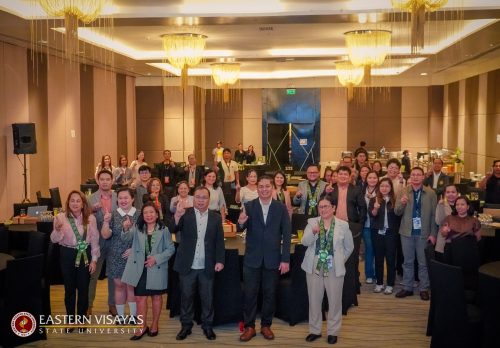
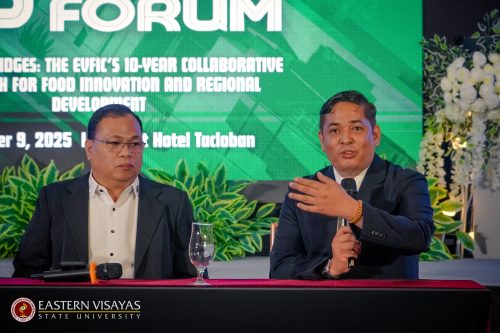
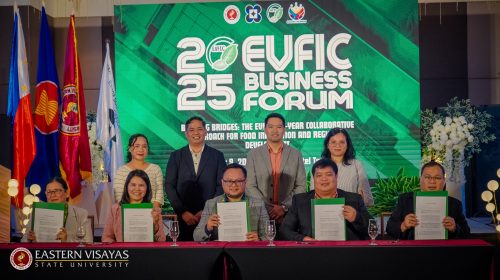
EVSU further expanded its cross-sectoral engagement through the 2025 EVFIC Business Forum, held on December 10, 2025, in celebration of the 10th anniversary of the Eastern Visayas Food Innovation Center (EVFIC). Under the theme Building Bridges: The EVFIC’s 10-Year Collaborative Approach for Food Innovation and Regional Development, the forum provided an avenue for government agencies, academic researchers, industry representatives, and micro, small, and medium enterprises (MSMEs) to exchange knowledge and discuss opportunities for strengthening the regional food innovation ecosystem.

The forum highlighted the role of research institutions and government-supported innovation facilities in translating scientific discoveries and technological developments into practical solutions for food production, processing, commercialization, and enterprise development. Through technology presentations, panel discussions, an open forum, and partnership-building activities, participants explored opportunities to improve food processing capabilities, strengthen MSME competitiveness, facilitate technology transfer, and promote value-adding enterprises in Eastern Visayas.

The involvement of the Department of Science and Technology (DOST), EVSU researchers, industry partners, and MSME stakeholders demonstrated the importance of bringing together research, government support mechanisms, and business capabilities to address challenges affecting the region’s food sector. Discussions emphasized stronger inter-agency collaboration, access to appropriate technologies, and the need to sustain partnerships that support innovation-driven and inclusive economic growth.

The forum exemplified EVSU’s role in facilitating dialogue beyond the academic sector by creating opportunities for researchers, government institutions, and entrepreneurs to identify shared development priorities and explore practical avenues for collaboration. It also reinforced the contribution of university-based research and innovation to food security, sustainable industrial development, and livelihood generation.

This initiative contributes to SDG 2 (Zero Hunger), SDG 8 (Decent Work and Economic Growth), SDG 9 (Industry, Innovation and Infrastructure), and SDG 17 (Partnerships for the Goals).

Participating in National and International Dialogues on Poverty Alleviation and Inclusive Sustainable Development

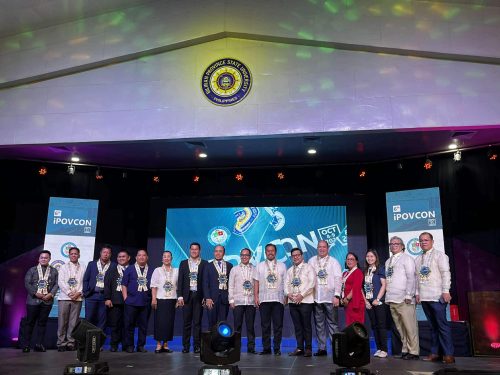
Beyond initiating and hosting stakeholder engagements within the region, EVSU actively participated in broader national and international platforms that promote dialogue on sustainable development. One significant engagement was its participation in the 6th International and 9th National Conference on Poverty Alleviation and Sustainable Development (iPOVCON 2025), held on October 8, 2025.

Co-hosted by Biliran Province State University, Samar State University, and the Department of Economy, Planning, and Development (DEPDev), the conference brought together representatives from higher education institutions, researchers, development practitioners, and government stakeholders to exchange perspectives on poverty reduction, inclusive development, and the application of technology in addressing socioeconomic challenges.

With the theme Technology-Driven Solutions for Poverty Alleviation and Inclusive Sustainability, the conference provided an academic and policy-oriented platform for examining how research, innovation, and institutional collaboration can contribute to reducing poverty and improving the quality of life of vulnerable communities.

EVSU’s participation was led by University President Dr. Dennis C. De Paz, together with faculty researchers Prof. Lady Winderose V. Oliverio, Prof. Ma. Theresa M. Salamida, Prof. Arnie M. Cadiente, and Prof. Joseph T. Gudelos. Their participation demonstrated the University’s institutional engagement in wider development conversations and its commitment to contributing academic knowledge and research-based perspectives to discussions on poverty alleviation and inclusive sustainability.

Through this participation, EVSU strengthened its connection with other state universities and government development-planning institutions, providing opportunities for knowledge exchange, research dissemination, and the identification of approaches that can be adapted to regional development priorities. This engagement reinforces the role of higher education institutions not only as producers of knowledge but also as active contributors to policy discussions and collaborative solutions addressing persistent development challenges.

The conference supports SDG 1 (No Poverty), SDG 9 (Industry, Innovation and Infrastructure), SDG 10 (Reduced Inequalities), and SDG 17 (Partnerships for the Goals).

Institutionalizing Collaboration as a Mechanism for Sustainable Development

EVSU’s cross-sectoral engagements in 2025 were further reinforced by its broader institutional partnerships with government agencies, volunteer organizations, research institutions, private enterprises, and development partners. These included its engagement with the Philippine National Volunteer Service Coordinating Agency (PNVSCA), collaboration with the Department of Science and Technology on science, technology, and disaster risk reduction initiatives, and partnerships supporting MSME innovation and technology development.

Such collaborations extend the University’s engagement beyond traditional academic functions by connecting its expertise, research capabilities, and extension services with the development priorities of external institutions and communities. They also create opportunities for sustained institutional relationships through which stakeholders can share information, coordinate activities, identify implementation challenges, and develop complementary interventions.

Through its participation in national and international academic conferences, its consultations with government and industry partners, and its organization of regional forums involving environmental agencies, NGOs, and community organizations, EVSU demonstrates that its commitment to the SDGs is reflected in concrete institutional engagement and collaborative action.

Expanding International Cross-Sectoral Dialogue Through the European Higher Education Fair 2025

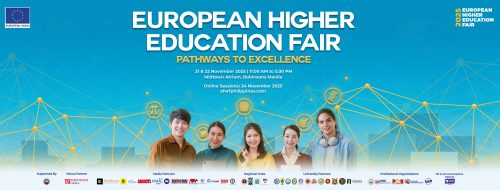
Further demonstrating its commitment to international cooperation and cross-sectoral engagement, Eastern Visayas State University (EVSU) participated in the European Higher Education Fair (EHEF) 2025 as the official Regional Hub for the Visayas, as announced in its November 11, 2025 institutional news release. Organized by the Delegation of the European Union to the Philippines, in collaboration with the embassies and cultural institutes of 14 European Union member states, the fair served as a major international platform connecting higher education institutions, government education agencies, international development partners, researchers, and prospective students to explore opportunities for academic cooperation, research collaboration, scholarships, and international mobility.

Under the theme Pathways to Excellence, EHEF 2025 brought together 95 higher education institutions, providing participants with opportunities to engage with representatives of European universities and explore international academic programs, scholarship opportunities, mobility schemes, and research partnerships. The event was supported by the Commission on Higher Education (CHED), with EVSU designated as the regional hub representing the Visayas, alongside the University of Santo Tomas for Metro Manila, the University of the Cordilleras for Luzon, and Xavier University–Ateneo de Cagayan for Mindanao.

As the official Visayas Regional Hub, EVSU assumed an important institutional role in extending the reach of this international education initiative and facilitating greater access for students, researchers, and academic personnel across the region. Its involvement strengthened the connection between regional higher education institutions and international academic networks, creating opportunities for knowledge exchange, institutional linkages, research collaboration, and the internationalization of higher education.

More significantly, this engagement demonstrates EVSU’s participation in a broader international dialogue on the future of education, academic excellence, global mobility, and equitable access to international learning opportunities. By working within a platform supported by CHED, the European Union Delegation, European diplomatic missions, and participating higher education institutions, EVSU contributed to strengthening cooperation between Philippine and European education stakeholders. It also reinforced the importance of international partnerships in addressing shared educational priorities, improving institutional capacities, and preparing graduates for an increasingly interconnected global environment.

Through its role as the Visayas Regional Hub, EVSU demonstrated that cross-sectoral dialogue for sustainable development is not limited to local consultations and national conferences but also encompasses international engagement that connects regional institutions with global knowledge networks and development opportunities. This initiative directly supports SDG 4 (Quality Education) by expanding access to international educational opportunities and strengthening academic cooperation, and SDG 17 (Partnerships for the Goals) by promoting international institutional linkages, knowledge exchange, and collaborative engagement across countries and higher education systems.

Advancing a Whole-of-Society Approach to the 2030 Agenda

Collectively, EVSU’s 2025 initiatives demonstrate an institutional approach to sustainable development that recognizes the interconnectedness of economic, social, environmental, and governance concerns. The University’s forums on waste management and climate resilience addressed environmental sustainability through the active involvement of government agencies and community stakeholders. Its industry consultations strengthened the relationship between higher education, government, and the private sector in promoting inclusive education and workforce development. Meanwhile, its participation in poverty alleviation conferences and its engagement with research and business stakeholders expanded opportunities for knowledge exchange, innovation, and coordinated regional development.

These engagements reflect EVSU’s understanding that cross-sectoral dialogue must go beyond ceremonial participation and partnership agreements. Meaningful collaboration requires creating spaces where stakeholders can articulate concerns, share evidence and technical expertise, assess existing challenges, discuss policy directions, and identify practical solutions that can be pursued collectively.

As a state university serving Eastern Visayas, EVSU continues to position itself as a catalyst for these conversations by leveraging its academic expertise, research capabilities, extension mandate, and institutional partnerships to connect national development priorities with regional and local needs.

Through these initiatives, the University contributes to a whole-of-society approach to achieving the Sustainable Development Goals, strengthening institutional accountability, promoting participatory development, and encouraging coordinated action among sectors. Ultimately, EVSU’s 2025 engagements affirm its commitment to SDG 17: Partnerships for the Goals, recognizing that sustainable and inclusive development can only be achieved when government, academe, industry, civil society, and communities work together toward shared objectives.

EXPLORE OUR SDG 17 INITIATIVES & ACTIVITIES

2026202520242023
SDG 17: Initiatives for 2026
SDG 17: Initiatives for 2025
SDG 17: Initiatives for 2024
SDG 17: Initiatives for 2023

EXPLORE OUR SDG 17 RESEARCH & PUBLICATIONS

202520242023
SDG 17: Publications for 2025
SDG 17: Publications for 2024
SDG 17: Publications for 2023

SUSTAINABLE DEVELOPMENT GOALS

20252024
2025: Sustainable Development Goals
2024: Sustainable Development Goals