

SDG 7 | AFFORDABLE AND CLEAN ENERGY
Energy Consumption Monitoring and Assessment
Eastern Visayas State University (EVSU) recognizes that effective energy management begins with a systematic understanding of how electricity is consumed across its facilities and campuses. As part of its institutional efforts to promote energy efficiency and responsible resource utilization, the University monitors and reviews its electricity consumption to assess energy demand, examine consumption patterns, identify campuses with relatively high electricity requirements, and determine opportunities for reducing unnecessary energy use. This process provides an important basis for evaluating the University’s energy utilization and informing decisions on energy conservation, operational improvements, and the adoption of energy-efficient technologies.
In Calendar Year (CY) 2025, EVSU consolidated its electricity consumption records covering the Main Campus and five component campuses: Carigara, Burauen, Tanauan, Ormoc, and Dulag. The consolidated report documented a total institutional electricity consumption of 1,934,712 kWh for the year. By compiling monthly consumption data across its geographically dispersed campuses, the University established an institutional overview of energy utilization, allowing comparisons of electricity demand among campuses and the identification of locations that contribute substantially to overall consumption.
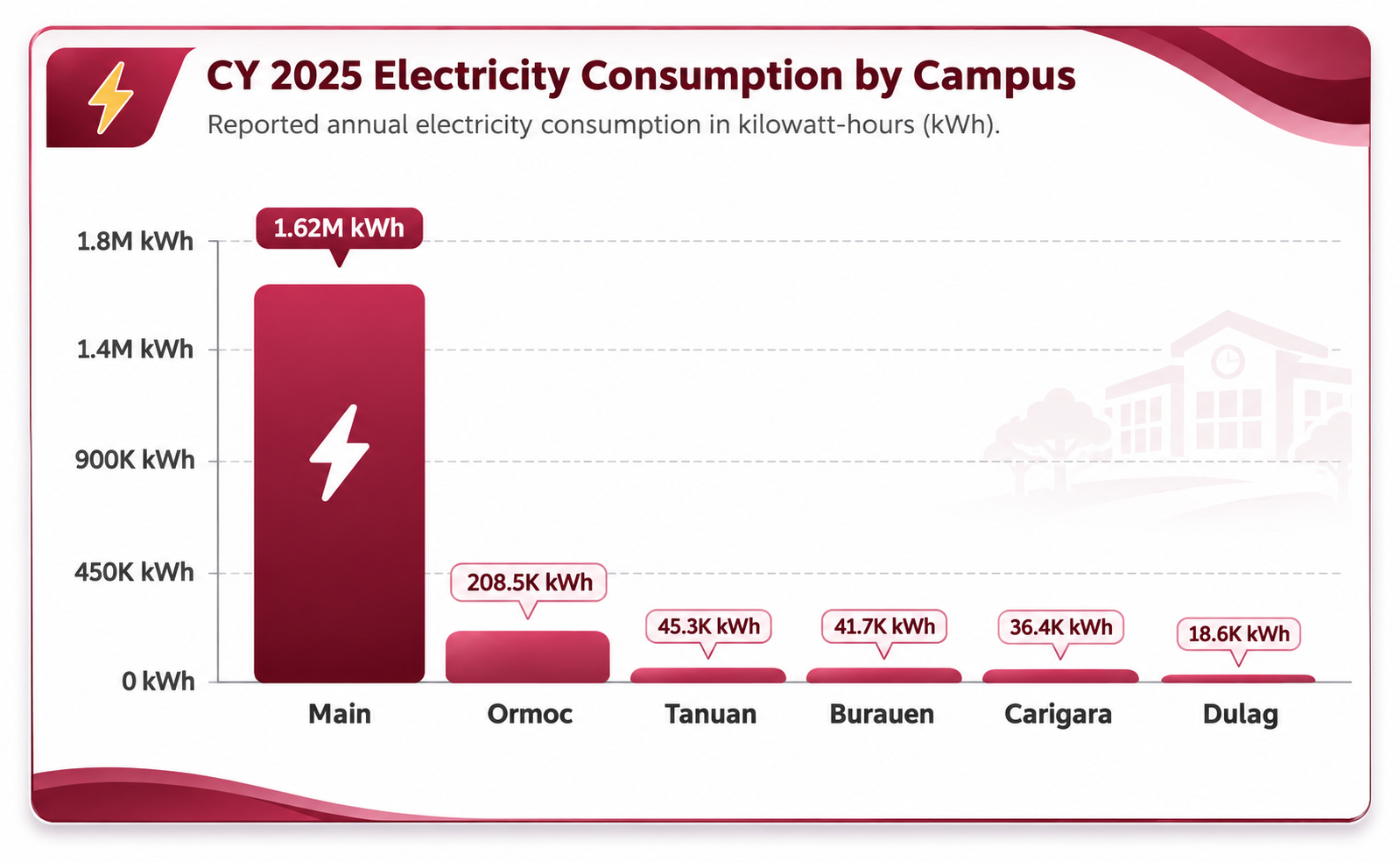
The campus-level assessment revealed considerable differences in electricity requirements. EVSU Main Campus registered the highest annual consumption at 1,582,178 kWh, accounting for approximately 81.8% of the University’s reported total electricity consumption. This was followed by EVSU–Ormoc Campus, with 226,194 kWh (approximately 11.7%), EVSU–Tanauan Campus, with 47,640 kWh (2.5%), EVSU–Burauen Campus, with 45,118 kWh (2.3%), EVSU–Carigara Campus, with 33,582 kWh (1.7%), and EVSU–Dulag Campus, with 12,466.10 kWh (approximately 0.6%). These figures provide a comparative picture of energy demand across the University’s campuses and help establish which facilities require greater attention in energy monitoring and conservation planning.
Beyond the annual totals, the University examined monthly electricity consumption to understand fluctuations in energy demand and identify periods of increased utilization. The consolidated monthly records showed a recurring pattern of variations throughout the year, with notable increases in March, May, and September. September registered the highest overall consumption, reaching approximately 200,000 kWh, while lower utilization levels were observed during October and November, at approximately 135,000 kWh. These variations provide useful information for examining the relationship between institutional operations, campus activities, and electricity requirements throughout the academic and operational calendar.
The individual campus consumption profiles further illustrate the value of conducting campus-level energy reviews. At the Main Campus, electricity consumption increased from January to March, declined slightly in April, and rose again to another high in May. Following a reduction during the succeeding months, consumption increased sharply in September before returning to more typical levels toward the end of the year. Given its substantial contribution to the University’s overall electricity demand, the Main Campus represents a significant priority for continued energy monitoring and the identification of potential energy-saving opportunities.
Similarly, EVSU–Ormoc Campus recorded an annual consumption of 226,194 kWh, with relatively stable electricity utilization from January to May, followed by a gradual decline through September. Consumption subsequently increased and reached its highest level in November before dropping to its lowest point in December. EVSU–Tanauan Campus, on the other hand, recorded relatively elevated and stable consumption during the first six months, generally ranging from 5,000 to 5,700 kWh monthly. A sustained downward trend was observed beginning in July, with a more pronounced decline from October to December. These consumption patterns provide opportunities for further assessment of operational requirements and the factors contributing to changes in electricity demand.
The other component campuses likewise demonstrated distinct consumption trends. EVSU–Burauen Campus recorded its highest monthly consumption in February at 4,591 kWh, followed by a gradual decline toward its lowest level in July at 3,144 kWh, before consumption gradually recovered during the succeeding months. EVSU–Carigara Campus registered an annual consumption of 33,582 kWh, with notable increases in April and September and lower consumption during January, June, and July. Meanwhile, EVSU–Dulag Campus recorded 12,466.10 kWh for the year. Its January-to-May electricity expenses were covered by the Local Government Unit (LGU), and therefore, no campus-recorded consumption data were reflected for this period. From June onward, electricity usage remained relatively stable during the initial months, increased sharply in August, and subsequently declined toward December. These campus-specific observations demonstrate the importance of examining not only consolidated institutional consumption but also the individual energy-use profiles of each campus.
The review also recognizes the University’s principal electricity requirements, which primarily support lighting, cooling, heating, and laboratory operations. Understanding these major uses provides an important reference for evaluating energy demand and identifying areas where electricity consumption may be optimized. The observed variations in monthly and annual consumption can guide further examination of building operations, the utilization of electrical equipment, and the efficiency of energy-consuming facilities. In particular, campuses and periods exhibiting relatively high consumption may be prioritized for closer monitoring and subsequent assessment of potential energy-saving interventions.
Through the consolidation and analysis of its CY 2025 electricity consumption records, EVSU demonstrates an institutional approach to energy monitoring that extends across its Main and component campuses. The assessment provides a quantitative baseline for comparing campus energy requirements, recognizing significant consumption patterns, and identifying areas that may warrant further investigation to prevent energy wastage. The resulting information supports evidence-based energy management decisions, including the prioritization of energy-efficient appliances and equipment, improvement of electricity-use practices, and reinforcement of responsible energy consumption among the University’s academic and administrative communities.
Ultimately, EVSU’s institutional electricity consumption review serves as an important component of its broader commitment to energy efficiency and sustainability. By continuously examining electricity utilization across its campuses, the University strengthens its capacity to recognize opportunities for conservation, improve operational efficiency, and promote the responsible use of energy resources in support of its sustainability objectives.