



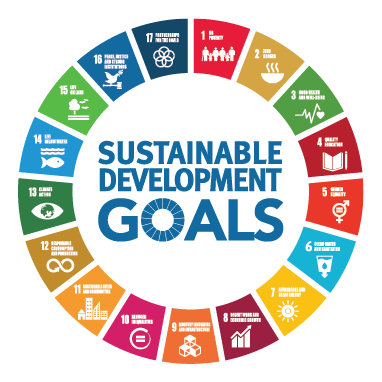
Eastern Visayas State University (EVSU) continues to advance its vision as a transformative institution in 2025, steadfast in its commitment not only to excellence in instruction, research, and extension, but also to shaping a resilient, inclusive, and sustainable future. Anchored on its aspiration to become the National University for Resiliency and Climate Action, EVSU upholds sustainability as both a strategic priority and a shared responsibility across all sectors of the university.
Guided by the principles of the United Nations’ 2030 Agenda for Sustainable Development, EVSU further strengthens the integration of the Sustainable Development Goals (SDGs) into its core functions. In 2025, the University deepens its SDG alignment by embedding sustainability-driven approaches in academic programs, expanding interdisciplinary research on climate and community resilience, and enhancing partnerships that address both local and global challenges. These efforts ensure that sustainability is not treated as a standalone agenda, but as a unifying framework that informs decision-making, innovation, and impact.
Building on the foundations established in previous years, EVSU continues to enhance its sustainability governance by promoting inclusive education, advancing health and well-being initiatives, strengthening environmental stewardship, supporting sustainable livelihoods, and fostering strong institutional collaborations. Through a whole-of-university approach, every initiative—whether in the classroom, in research laboratories, in communities, or within campus operations—contributes to the realization of the SDGs and the broader goal of sustainable development.
This 2025 report captures the collective efforts of the EVSU community—its students, faculty, staff, and partners—whose dedication drives meaningful and measurable change. It reflects the University’s enduring commitment to responsible leadership, ethical governance, and transformative action as it continues to serve as a catalyst for sustainable development in Eastern Visayas and beyond.
SDG 7: Affordable and Clean Energy – EVSU 2025 Initiatives
Eastern Visayas State University (EVSU) advances Sustainable Development Goal 7: Affordable and Clean Energy through institutional commitments to energy efficiency and conservation, research and innovation in renewable energy technologies, and the integration of sustainable energy principles into campus infrastructure development. These efforts reflect the University’s recognition of the importance of ensuring reliable and sustainable energy use while reducing the environmental impacts associated with its operations.
In 2025, EVSU recorded a total electricity consumption of 1,934,712 kilowatt-hours (kWh), equivalent to approximately 6,964.96 gigajoules (GJ), based on its electricity usage records. The University’s electricity supply is obtained through the Eastern Visayas distribution network, which is connected to the Luzon-Visayas Interconnected Grid. Beyond monitoring the volume of electricity consumed, EVSU also evaluates the environmental implications of its electricity use through carbon footprint assessment. This allows the University to account for emissions associated with purchased electricity and establish a basis for identifying opportunities to improve energy efficiency and reduce its carbon footprint. The assessment also provides a framework for examining the contribution of low-carbon energy sources within the electricity supply mix.
The University’s commitment to clean and sustainable energy is further demonstrated through its support for research and innovation in renewable energy technologies. A notable accomplishment in 2025 was the international recognition received by Prof. Ferdinand C. de la Cruz, an EVSU faculty-researcher, for his study entitled “Evaluation of Performance of the Developed Solar-Powered Portable Multi-Gas Detector Device.” Published in the International Journal of Open-access, Interdisciplinary and New Educational Discoveries (iJOINED ETCOR), Volume IV, Issue 4, October–December 2025, the research featured a solar-powered portable device designed to detect hazardous gases, including carbon monoxide, methane, and hydrogen sulfide. Its use of solar energy enables continuous operation, including in remote and off-grid locations, demonstrating the potential of renewable energy applications in environmental monitoring, occupational safety, and community protection. This achievement highlights EVSU’s capacity to generate locally relevant technological solutions that combine clean energy applications with public safety and environmental sustainability.
EVSU also incorporated energy efficiency and renewable energy considerations into its infrastructure development plans. In 2025, the University’s Terms of Reference for the construction of the four-storey College of Arts and Sciences Extension at the Main Campus included provisions for an Energy Efficiency Plan and renewable energy integration under its green building requirements. The building design specifications identified energy-efficient electrical systems, high Energy Efficiency Ratio (EER) equipment, natural ventilation, and measures to reduce electricity consumption. The electrical design guidelines likewise specified the use of LED lighting fixtures, occupancy and daylight sensors, and provisions for improved energy management. These design requirements demonstrate the University’s effort to incorporate energy-conscious planning into new campus facilities and reduce the long-term energy demands of its infrastructure. The inclusion of a renewable energy system in the project requirements further reflects the University’s direction toward integrating clean energy technologies into campus development.
These initiatives are guided by EVSU’s institutional policy on affordable and clean energy, which is aligned with the Renewable Energy Act of 2008 (Republic Act No. 9513) and the Energy Efficiency and Conservation Act of 2019 (Republic Act No. 11285). Under this policy, the University commits to promoting renewable energy adoption, implementing energy conservation measures, developing campus-based renewable energy laboratories and demonstration sites, and integrating energy sustainability into instruction, research, and extension services. It also emphasizes partnerships with government agencies, industries, and other stakeholders to support investments in clean energy technologies and expand energy literacy among communities.
Through these initiatives, EVSU demonstrates its contribution to SDG 7 not only by monitoring and assessing its institutional electricity consumption but also by supporting renewable energy research, incorporating energy-efficient features into infrastructure planning, and establishing a policy direction for the transition toward cleaner energy. Moving forward, the University aims to strengthen the implementation of renewable energy projects, improve energy performance across its campuses, and expand research and community engagement activities that promote accessible, affordable, and sustainable energy solutions in Eastern Visayas.
SDG 7 in Action: EVSU’s 2025 Affordable and Clean Energy Initiatives
Through its holistic approach to sustainability, Eastern Visayas State University (EVSU) demonstrates that each initiative—whether in health, education, economic development, or collaborative partnerships—contributes to a larger, integrated vision of progress aligned with the United Nations’ 2030 Agenda. By embedding the principles of the Sustainable Development Goals across research, teaching, extension, and governance, EVSU not only addresses immediate regional and national challenges but also equips future leaders to innovate responsibly, act ethically, and advocate for inclusive growth.
As EVSU moves forward, the university remains committed to tracking measurable outcomes, strengthening stakeholder engagement, and fostering transformative partnerships that accelerate the attainment of all 17 SDGs. This report reflects EVSU’s unwavering dedication to building a resilient, equitable, and sustainable future—demonstrating that collective action, guided by knowledge and ethical stewardship, can truly make a lasting impact for generations to come.


















