

SDG 8 | Decent Work and Economic Growth
Institutionalized Grievance and Appeal Mechanism for the Protection of Employee Rights and Compensation
Institutional Commitment to Employee Rights and Fair Compensation
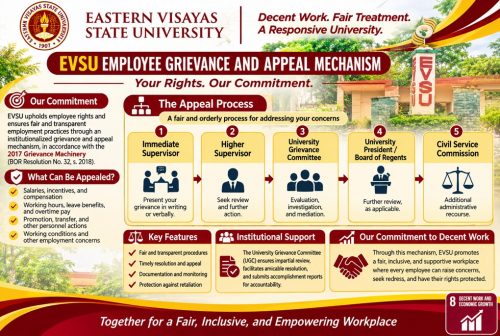
Eastern Visayas State University (EVSU) upholds its commitment to protecting employee rights, promoting fair employment practices, and ensuring accountability in human resource administration through an institutionalized grievance and appeal mechanism. Recognizing that employees must have accessible and reliable avenues to question employment decisions, raise concerns regarding their working conditions and compensation, and seek appropriate remedies when their rights or benefits are affected, the University maintains a formal grievance-resolution framework through its 2017 Grievance Machinery, approved by the EVSU Board of Regents under Board Resolution No. 32, s. 2018.
The Grievance Machinery serves as the University’s institutional process for receiving, evaluating, and resolving employee complaints and appeals. It provides faculty members and non-teaching personnel with established procedures for bringing forward concerns involving the implementation of personnel policies, employment rights, compensation, benefits, promotion, workload, and other conditions of service. Through this mechanism, EVSU reinforces the principle that employment-related concerns must be addressed through transparent, systematic, and procedurally fair processes.
Coverage of Compensation, Economic Rights, and Employment-Related Concerns
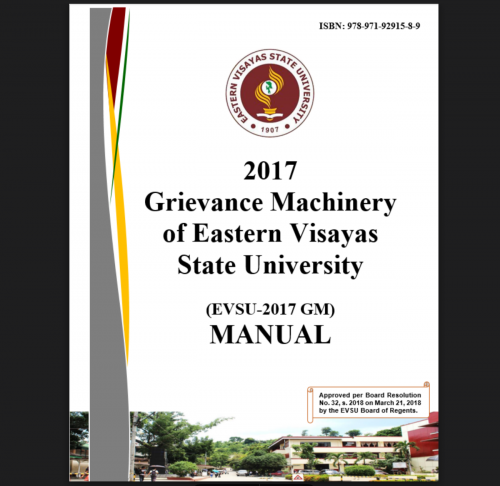
A significant feature of EVSU’s Grievance Machinery is its explicit recognition of grievances involving employees’ economic and financial rights. Under Section 11.1 of the Manual, employees may raise concerns involving the non-implementation of policies and procedures on economic and financial matters, including salaries, incentives, working hours, leave benefits, delayed processing of overtime pay, and unreasonable withholding of salaries.
This provision provides employees with a formal avenue to question compensation-related practices and seek appropriate administrative action when salary payments, financial entitlements, or employment benefits are not properly implemented. It is particularly relevant to the University’s commitment to decent work because it recognizes that fair and consistent compensation administration is an essential component of employee welfare and economic security.
Furthermore, Section 11.2 covers grievances concerning recruitment, promotion, transfer, retirement, termination, and other employment-related matters. These provisions extend the protection of the grievance mechanism beyond compensation to other important aspects of the employment relationship, helping ensure that personnel decisions are subject to established institutional procedures and appropriate review.
University Grievance Committee: Institutional Mechanism for Resolving Employee Complaints
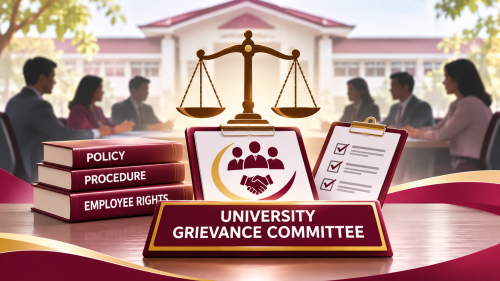
The implementation of the grievance process is supported by the University Grievance Committee (UGC), which serves as the University’s designated mechanism for facilitating the resolution of employee grievances. The Committee provides an institutional venue where complaints may be formally evaluated, investigated, and addressed in accordance with applicable Civil Service Commission regulations and University policies.
Its responsibilities include receiving and evaluating employee grievances, facilitating discussions between concerned parties, conducting investigations and hearings when necessary, promoting amicable settlements, and recommending appropriate courses of action. Through these functions, the Committee helps ensure that employee concerns receive due consideration and are addressed based on relevant policies, established procedures, and the circumstances of each case.
The Committee also contributes to institutional accountability by documenting grievance proceedings, monitoring unresolved concerns, and preparing reports on its accomplishments and the status of cases. These responsibilities provide a mechanism for identifying recurring employment-related issues and informing improvements in the University’s human resource management practices.
Established Grievance Filing and Appeal Procedures
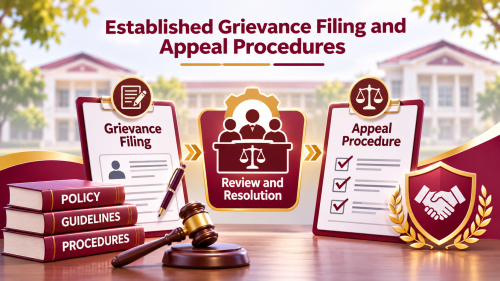
To provide employees with an orderly and accessible means of seeking redress, EVSU’s Grievance Machinery establishes a progressive grievance-resolution and appeal procedure under Section 36 of the Manual. This process allows employees to elevate their concerns through successive levels of administrative review when an initial resolution is considered unsatisfactory.
The process generally follows these stages:
- Initial Presentation to the Immediate Supervisor. An employee may initially communicate a grievance verbally or in writing to the immediate supervisor, providing an opportunity for the concern to be addressed at the unit or office level.
- Elevation to the Higher Supervisor. If the employee is dissatisfied with the action taken or the concern remains unresolved, the grievance may be elevated to the next higher administrative authority for further consideration and appropriate action.
- Referral to the University Grievance Committee. When the matter remains unresolved, the employee may elevate the grievance to the UGC for formal evaluation, investigation, mediation, or hearing, as appropriate. The Committee provides an institutional mechanism for examining the complaint and facilitating a fair resolution.
- Further Administrative Appeal within the University. Employees who remain dissatisfied with the resolution may pursue further administrative review through the appropriate higher university authorities, including the University President and the Board of Regents, subject to the applicable grievance procedures.
- Elevation to the Civil Service Commission. For grievances that remain unresolved after the prescribed university-level process, employees may seek further administrative recourse through the Civil Service Commission Regional Office VIII, in accordance with applicable requirements and procedures. The Certificate of Final Action on the Grievance (CFAG), when required, serves as supporting documentation for the elevation of the case.
This progressive procedure ensures that employees have multiple avenues to present their concerns, obtain administrative review, and seek appropriate remedies. It also promotes accountability by establishing responsibilities at different levels of the University’s administrative structure.
Documentation, Monitoring, and Institutional Accountability
EVSU’s grievance mechanism is further reinforced by documentation and monitoring requirements that support the systematic handling of employee complaints. The prescribed grievance forms and related documentation provide a basis for recording complaints, tracking the actions taken, and documenting the disposition of cases.
The University Grievance Committee is also responsible for monitoring the status of grievances, including unresolved cases, and preparing periodic accomplishment reports for submission to the appropriate authorities. These reporting requirements strengthen institutional oversight and provide opportunities to assess the effectiveness of grievance-resolution procedures, identify recurring workplace concerns, and recommend appropriate improvements to employment policies and administrative practices.
Through these mechanisms, EVSU recognizes that protecting employee rights requires not only the existence of a formal grievance policy but also an institutional commitment to receiving, documenting, reviewing, and appropriately addressing employee concerns.
EXPLORE OUR SDG 8 INITIATIVES & ACTIVITIES
EXPLORE OUR SDG 8 RESEARCH & PUBLICATIONS
SUSTAINABLE DEVELOPMENT GOALS