



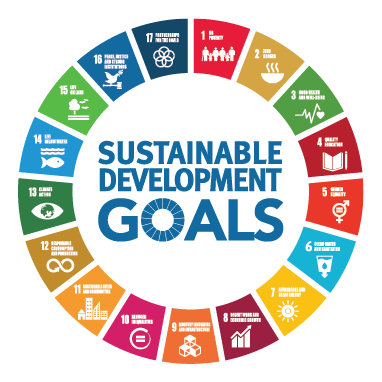
Eastern Visayas State University (EVSU) continues to advance its vision as a transformative institution in 2025, steadfast in its commitment not only to excellence in instruction, research, and extension, but also to shaping a resilient, inclusive, and sustainable future. Anchored on its aspiration to become the National University for Resiliency and Climate Action, EVSU upholds sustainability as both a strategic priority and a shared responsibility across all sectors of the university.
Guided by the principles of the United Nations’ 2030 Agenda for Sustainable Development, EVSU further strengthens the integration of the Sustainable Development Goals (SDGs) into its core functions. In 2025, the University deepens its SDG alignment by embedding sustainability-driven approaches in academic programs, expanding interdisciplinary research on climate and community resilience, and enhancing partnerships that address both local and global challenges. These efforts ensure that sustainability is not treated as a standalone agenda, but as a unifying framework that informs decision-making, innovation, and impact.
Building on the foundations established in previous years, EVSU continues to enhance its sustainability governance by promoting inclusive education, advancing health and well-being initiatives, strengthening environmental stewardship, supporting sustainable livelihoods, and fostering strong institutional collaborations. Through a whole-of-university approach, every initiative—whether in the classroom, in research laboratories, in communities, or within campus operations—contributes to the realization of the SDGs and the broader goal of sustainable development.
This 2025 report captures the collective efforts of the EVSU community—its students, faculty, staff, and partners—whose dedication drives meaningful and measurable change. It reflects the University’s enduring commitment to responsible leadership, ethical governance, and transformative action as it continues to serve as a catalyst for sustainable development in Eastern Visayas and beyond.
SDG 8: Decent Work and Economic Growth – EVSU 2025 Initiatives
EVSU’s contribution to Sustainable Development Goal 8: Decent Work and Economic Growth is reflected in its efforts to promote fair and secure employment, strengthen workforce readiness, develop practical and technical skills, and support entrepreneurship and local enterprise development. The University’s 2025 initiatives demonstrate how its academic, research, extension, and human resource functions contribute to employability and inclusive economic participation in Eastern Visayas.
In 2025, EVSU strengthened its contribution to decent work and inclusive economic growth through initiatives that expanded employment opportunities, enhanced workforce readiness, developed technical and livelihood competencies, and supported innovation-driven enterprise development. These efforts were complemented by institutional human resource practices that promote employment security, merit-based career advancement, gender inclusion, and professional development.
A significant employment initiative was the University’s participation in the 2025 Government Job Fair, organized in partnership with the Civil Service Commission Regional Office VIII as part of the 125th Philippine Civil Service Anniversary. Held on September 7, 2025, at Robinsons North Tacloban, the event provided an employment platform for fresh graduates, career shifters, and other job seekers. Through its Hired-On-the-Spot (HOTS) Contract-of-Service Program, EVSU hired 14 applicants on the spot, providing immediate employment opportunities and contributing to workforce development in the region.
Beyond direct employment opportunities, EVSU continued to strengthen students’ preparation for the labor market through supervised internships, on-the-job training (OJT), practicum programs, and other work-integrated learning arrangements. Facilitated by the University’s OJT and Job Placement Office in coordination with academic units, these placements connect students with government agencies, private enterprises, local industries, and other partner organizations. Through actual workplace exposure, students develop technical competencies, communication and interpersonal skills, professionalism, and practical experience relevant to their respective fields. These initiatives help bridge academic preparation and employment, equipping graduates with the competencies needed to transition into the workforce.
The University also extended its contribution to decent work and economic empowerment through community-based technical and vocational training. One notable example was the FORGE Extension Project, implemented by the School of Technology in partnership with Side-by-Side Alliance Inc. The project provided welding instruction to residents of Barangays Pitogo and Catoogan in Sta. Fe, Leyte, with its culminating activity held on October 24, 2025. The training equipped participants with practical competencies relevant to welding-related employment and livelihood opportunities. Notably, five beneficiaries had already earned Welding National Certificate II (NC II), demonstrating the project’s contribution to developing skills recognized under national technical-vocational standards.
Similarly, EVSU–Carigara Campus implemented the Capacity Advancement and Training for Community Harvesters (CATCH) in Fisheries Project, conducting specialized training on mangrove crab culture on January 31, 2025, at the EVSU–Carigara Aquafarm in Barangay Parina, Carigara, Leyte. In collaboration with the Municipal Agriculture Office, BFAR Region VIII, and DSWD, the initiative provided beneficiaries of the DSWD Sustainable Livelihood Program with practical knowledge on crab biology, sustainable culture techniques, crab fattening, and pond and pen management. Linked to the Mud Crab Culture Project, the training aimed to strengthen the livelihood capacities of two fisherfolk organizations in Barangay Parina and promote sustainable aquaculture as an economic opportunity for local communities.
EVSU likewise supported inclusive economic growth by strengthening the innovation and entrepreneurial capacities of micro, small, and medium enterprises (MSMEs). On June 3, 2025, the University and the Department of Science and Technology (DOST) formalized a partnership through a Memorandum of Agreement for the project “Integrating Innovation through Technical Assistance and Commercialization of New Products for MSMEs in Eastern Visayas.” The collaboration seeks to provide local enterprises with access to technical assistance, research-based solutions, new technologies, and expert support to improve their products and business capabilities. This partnership was complemented by the 2025 EVFIC Business Forum, held on December 10, 2025, in celebration of the Eastern Visayas Food Innovation Center’s tenth anniversary. The forum brought together government agencies, researchers, industry representatives, and MSMEs to explore opportunities in food innovation, technology transfer, product commercialization, and enterprise development. Through these activities, EVSU reinforces the role of research and innovation in improving the competitiveness of local businesses and creating opportunities for sustainable economic growth.
The University’s commitment to entrepreneurship and technology commercialization was further demonstrated through the 2025 IPTBM Technology Pitching Competition, held on September 23, 2025. Organized by the Intellectual Property and Technology Business Management (IPTBM) unit, the competition featured innovations developed by faculty members and non-teaching personnel, including technologies in food innovation, product development, and equipment design. By providing a platform for presenting and evaluating technology prototypes, the initiative encouraged innovation, strengthened commercialization opportunities, and promoted the transformation of university-generated knowledge into potential products and enterprises.
At the institutional level, EVSU continued to uphold decent employment through merit-based and inclusive human resource management. The University attained Maturity Level II accreditation across all four core systems under the Civil Service Commission’s Program to Institutionalize Meritocracy and Excellence in Human Resource Management (PRIME-HRM): Recruitment, Selection, and Placement; Learning and Development; Performance Management; and Rewards and Recognition. This recognition affirms the University’s established human resource systems and its commitment to transparent recruitment, objective performance evaluation, employee development, and equitable opportunities for career advancement.
The University’s 2025 employment records further demonstrate its efforts to maintain workforce stability. Out of 1,292 employees, 1,241 or 96.05% were classified as having secure employment arrangements exceeding 24 months. This reflects the University’s continued emphasis on employment continuity and personnel welfare. In addition, EVSU recorded 665 male employees and 627 female employees, with women representing 48.53% of the total workforce. Through sex-disaggregated personnel data and coordination between the Human Resource Management Office and the Gender and Development Office, the University monitors workforce representation and supports gender-responsive human resource planning and compensation practices.
Overall, EVSU’s 2025 initiatives demonstrate its contribution to SDG 8 through employment facilitation, work-integrated learning, technical-vocational training, livelihood development, MSME support, research commercialization, and responsible human resource management. By connecting education and research with practical employment opportunities and enterprise development, the University contributes to strengthening individual livelihoods, improving workforce capabilities, and supporting inclusive economic development in Eastern Visayas.
SDG 8 in Action: EVSU’s 2025 Decent Work and Economic Growth Initiatives
Through its holistic approach to sustainability, Eastern Visayas State University (EVSU) demonstrates that each initiative—whether in health, education, economic development, or collaborative partnerships—contributes to a larger, integrated vision of progress aligned with the United Nations’ 2030 Agenda. By embedding the principles of the Sustainable Development Goals across research, teaching, extension, and governance, EVSU not only addresses immediate regional and national challenges but also equips future leaders to innovate responsibly, act ethically, and advocate for inclusive growth.
As EVSU moves forward, the university remains committed to tracking measurable outcomes, strengthening stakeholder engagement, and fostering transformative partnerships that accelerate the attainment of all 17 SDGs. This report reflects EVSU’s unwavering dedication to building a resilient, equitable, and sustainable future—demonstrating that collective action, guided by knowledge and ethical stewardship, can truly make a lasting impact for generations to come.


















