

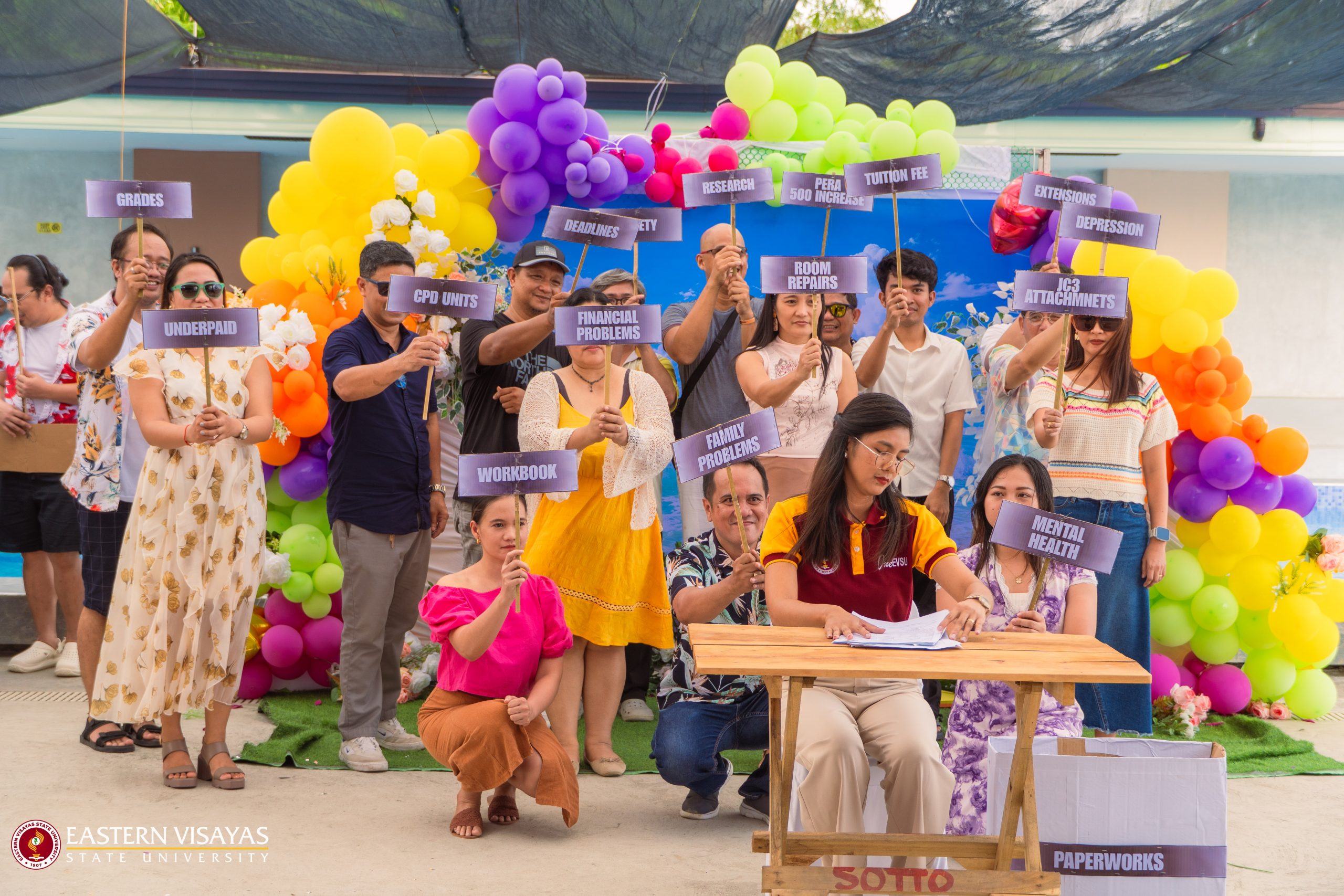
Four hundred educators stepped away from their grading sheets, laboratory reports, and syllabi on October 5, 2026. They gathered at Divina’s Pool in San Jose, Tacloban City, trading the rigid four corners of the classroom for a full day of recognition, laughter, and shared stories. The Eastern Visayas State University (EVSU) community came together to celebrate World Teachers’ Day 2026.
The university designed an eight-hour program, running from 8:00 AM to 5:00 PM, to honor the people who shape the minds of the EVSUnistas. They called the event “Teacher IKAW Naman: Inclusive Knowledge and Advocacy-driven Work”. This specific institutional theme adapted the Tagalog word “IKAW” into an acronym reflecting the university’s Gender and Development (GAD) agenda. The administration aligned the entire event with Republic Act No. 10743, the law declaring October 5 as National Teachers’ Day, which former President Benigno S. Aquino III approved on January 29, 2016.
Ms. Linel R. Martinez, a former Miss EVSU and current part-time instructor, grabbed the microphone alongside her co-emcee, Mr. Jonathan R. Ramirez, Jr.
“GADmorning, EVSUUUUUU!” they shouted, prompting a loud response from the crowd. The emcees promised a day free from chasing students for submissions.
Dr. Analyn C. Españo, Vice President for Academic Affairs, opened the formal program. She emphasized the heavy responsibility teachers carry in shaping individuals and developing society. Near the registration tables, faculty members wrote appreciation notes on the “EVSU IKAW Naman: Saludo sa Lahing Guro” Wall. The organizers instructed them to use gender-fair language to thank peers who model inclusive practices.
Administrative Realities and Wins
University President Dr. Dennis C. de Paz took the stage for the inspirational message. He looked at the gathered deans, campus directors, and instructors. He did not offer empty platitudes. Instead, he gave the faculty a transparent look into the university’s ongoing projects, financial hurdles, and administrative wins.
He borrowed words from American author Guy Kawasaki.
“If you have to put someone on a pedestal, you have to put teachers. They are society’s heroes.”
Dr. de Paz acknowledged the increasing difficulty of academic work, specifically the demanding accreditation and reclassification processes. He then delivered news that directly impacted the careers of the faculty in the audience. The Board of Regents had recently approved a new institutional promotion system.
He detailed the mechanics of this change. The administration converted 13 available Associate Professor V positions through a “scrap and build” process to create Assistant Professor 1 slots. This move allowed hardworking Instructor 1 faculty members—those actively doing research and extension work—to finally apply for reclassification.
The president also addressed infrastructure and financial hurdles. EVSU faces a massive monthly electricity bill exceeding two million pesos. To combat this, Dr. de Paz submitted seven proposals to Congress aimed at solarizing five buildings on campus. He wanted to reallocate those utility funds toward building repairs.
He shared major updates on the external campuses as well. The Burauen Campus, previously neglected without new structures for years, now boasts a new administration building and a soon-to-be-completed dormitory. The Tanauan Campus also secured a new dormitory, while the Main Campus pushes forward with Phase 2 of the Arts and Sciences building. He praised the EVSU team for their sleepless nights securing the smart campus project.
He did not shy away from controversies. He addressed a terminated contract with a supplier named “Lancaster,” explaining that the contractor failed to improve performance despite the university paying them. He asked the faculty for understanding and prayers as the administration handles these complicated legal and contractual processes.
Safe Spaces and Boundaries
At around 10:00 AM, the tone shifted to legal and social protections. Atty. Rodolph B. Hernandez, Jr., Chief Legal Officer, stepped up to discuss the Safe Spaces Act, also known as the Bawal Bastos Law or Republic Act No. 11313.
He opened with a joke, acknowledging that teachers might find a seminar boring when a swimming pool waits outside, promising to keep his talk strictly to 15 minutes. Then, he laid out the hard facts.
Atty. Hernandez explained the historical shift in Philippine sexual harassment laws. The older Anti-Sexual Harassment Act of 1995 (RA 7877) required “moral ascendancy”. This meant a victim could only prosecute if the perpetrator held authority over them in the workplace or school. RA 11313 completely removed that requirement. Now, a student can be held accountable for sexually harassing a teacher, and a peer can be held legally accountable for harassing a colleague.
He warned the faculty about becoming too comfortable with one another.
“Because we work together, we eat together, you survive accreditation together, but that still does not give unlimited permission to comment on each other’s bodies, relationships, or sexualities.”
To illustrate the severity of body shaming, he cited a case from India. A doctor made a YouTube video shaming a Malayalam actress’s body after she declined a corporate event invitation. The Indian courts ruled that body shaming is entirely unacceptable in society. Atty. Hernandez used this to remind the EVSU faculty that comments about weight, height, and skin color cross legal lines.
Atty. Hernandez provided highly specific, actionable advice for the digital age. He urged teachers to use official channels like the Learning Management System (LMS) or university email rather than personal social media for academic instructions. Many teachers created their Facebook accounts back in 2009 or 2010 when they were much younger, and mixing that with professional access causes problems. He advised creating separate messenger accounts for private and official matters to establish clear boundaries with students.
He gave strict instructions on handling harassment reports. He told the faculty to preserve evidence, avoid posting screenshots to the public, seek security for immediate physical danger, and never retaliate against a reporting student with a failing grade.
To drive the point home, he conducted a rapid-fire “Myth or Fact” quiz. He debunked the idea that harassment is just a woman’s issue, clarified that jokes can indeed constitute harassment, and firmly stated that a student wearing a crop top or mini skirt is never asking for harassment.
Stories of Change
Following a gender-inclusive wellness break that accommodated dietary needs and provided accessible spaces, the program moved to its most intimate segment. Titled “EVSU IKAW Naman: Stories of Women and Men Educators Leading Change at EVSU,” this part of the morning featured two deeply personal speeches.
Mr. Mark Reynan C. Sabayan took the microphone first. Sabayan is a master’s in management (MM), Certified Guest Service Professional (CGSP), and Certified Hospitality Management Professional (CHMP). He is also a regional qualifier for the CSC Dangal ng Bayan Awards and a finalist for the Outstanding Eastern Visayan Awards.
He structured his speech in three parts: the past, the present, and the future. Sabayan started as a Hotel and Restaurant Technology student at EVSU. He brought a love for food from his grandmother’s kitchen in Palo, but his teachers molded him into a professional. He specifically thanked Dr. Hilaria L. Bustamante and the late Ma’am Nazarena Aguirre.
Sabayan recalled a specific moment of intense pressure. A teacher once stopped at his station, tasted his work, offered pure silence, and simply commanded, “Again”. He admitted he felt angry at the time, wondering what he did wrong. Years later, he realized she simply refused to let him settle for ordinary.
Back in 2007, he worked as a student volunteer known as the “Waiter ng Bayan”. He served in the homes of many deans and became the personal server for university presidents. His teachers taught him three things: discipline, humility, and the ability to see himself differently.
Today, Sabayan teaches Culinary Arts, Food and Beverage Management, Commercial Cookery, and Food Safety. He demands real-world pressure in his laboratory. He pushes his students to think like artists during food styling workshops, reminding them that “the eyes eat first”. He admitted to using his own money to equip the laboratory so his students could train with proper tools.
During an accreditation, an accreditor told him that a teacher’s efficiency is seen in whether they create a version of themselves, a “mini-me”. He wants his students to carry his fire, not just copy him. He asks them to document, prepare, and present Eastern Visayas heritage dishes as a core requirement. They must interview elders and research the origins of local food to become guardians of their culture.
His personal advocacy is “Rasa Sinirangan,” which translates to “Flavor of the East”. Troubled by the dominance of foreign cuisine in the region, he traveled across Leyte, Samar, and Biliran to document over a hundred heritage recipes. He learned Kinarabu from a 99-year-old matriarch in Palo and Lawot-Lawot in Burauen. Through Project A.S.P.I.R.E. (Aim to Train Sustainable Food Producers Initiating Reforms and Enhancements), a module he crafted for the Department of Tourism, he has trained over a thousand community workers.
“My dream for the future is simple. I want a Waray child to grow up proud of the food on their table,” Sabayan told the crowd. “And I want EVSU to be known as the university that helped Eastern Visayas taste its own heritage again.”
Ma’am Siozon spoke next. Her story traced a difficult path from Barangay Cancaraja in Pastrana, Leyte. She walked three kilometers every single day just to reach school. She faced a reality where families routinely chose between education and basic survival.
She held onto a singular belief that education changes lives. That belief pushed her to become a university faculty member and eventually the recipient of the 2024 Dangal ng Bayan Award. She traveled to Malacañang to accept the honor as an outstanding EVSU extensionist.
Siozon challenged the audience to rethink their roles. She asked them what they plan to do with their knowledge and who they intend to bring along. For her, inclusive knowledge means stepping far outside the classroom. Over her 10 years at EVSU, she mentored students, worked with farmers, shared technical knowledge, and conducted livelihood activities.
She read off the eight norms of conduct for public servants: Commitment to Public Interest, Professionalism, Justness and Sincerity, Political Neutrality, Responsiveness to the Public, Nationalism and Patriotism, Commitment to Democracy, and Simple Living.
“Do not work for the award,” she urged her peers. “Work for the people. Work for your students, the community, for EVSU, and for the country.”
Camaraderie and Competition
By around 11 AM, the heavy emotional lifting gave way to high-energy competition. The School of Education Physical Education (SED-PE) department took charge of the engagement and team-building activities.
The emcees conducted an energy check, calling out each academic school by name to test their volume and spirit. Teachers dropped their professional guards. They cheered, strategized, and competed in games designed to break down departmental silos. The activities reminded everyone that a strong academic community requires cooperation and shared laughter.
At noon, the group transitioned to the “Kamustahay” lunch. The university allocated 340,000 pesos from the IGF budget to cover the meals and venue for the 400 attendees, breaking down to 850 pesos per head. The School of Technology handled the meal arrangements, deliberately designing seating plans to encourage cross-unit interaction. They mixed genders and departments at the tables. The menu accommodated various health conditions, including options for pregnant, diabetic, and hypertensive attendees. It was an hour dedicated to simply asking a colleague, “Kamusta ka?”.
Recognizing Excellence
The afternoon session opened with formal recognition. Dr. Glenda B. Tupaz, Director of Gender and Development, explained the rationale behind the IKAW Advocacy-driven Educator Award. This award specifically highlighted gender-balanced contributions aligned with the university’s National University for Resilience and Climate Action (NURCA) and GAD advocacies.
The activity directly supported the Magna Carta of Women (Republic Act No. 9710) and relevant CHED GAD policies. University officials presented the awards, giving physical proof that EVSU sees and values the extra hours educators put into their advocacies.
The community then formally welcomed its newest members through the “Kilal-a Ta: Pag-abiabi han Aton Bag-o nga mga Kaupod” ceremony. The induction served as a rite of passage for the new faculty. The emcees reminded the fresh recruits that they were no longer just new faces, but active participants in a community that learns and serves together.
Then, the stage transformed for “IKAW ang Bida!”. Faculty members from SAAD, SAME, SAS, SED, SOE, and SOT stepped into the spotlight. They swapped their lecture voices for singing, dancing, and theatrical performances. The crowd erupted, proving that EVSU teachers hold talents far beyond writing syllabi and grading papers.
More fellowship games followed at 3:00 PM under the banner “IKAW Naman, Laro Tayo!”. The SED-PE department once again led the charge, serving afternoon snacks and organizing activities meant to simply let the educators pause, breathe, and recharge.
As the clock pushed toward 4:30 PM, the energy did not fade. The School of Education initiated a massive “Zumba for All” session. Hundreds of teachers, deans, and administrators moved to the music, sweating out the stress of the academic year.
Dr. Danilo B. Pulma, Vice President for Administration, Finance and Auxiliary Services, delivered the final remarks. He looked out at the tired but smiling faces of the EVSU teaching force. The day met its specific goals. The university celebrated its teachers, trained them on safe spaces, recognized their advocacy work, and gave them room to breathe.
The event proved exactly what Sabayan quoted earlier in the day from Jim Rohn. EVSU teachers strive to be strong, but not rude; kind, but not weak; bold, but not bullies; humble, but not timid; and proud, but not arrogant.
EVSUFA President Sir Chris Bacungan and the organizers watched as the educators packed up to leave Divina’s Pool. They would return to their classrooms and laboratories. They would face the two-million-peso monthly electricity bills, the accreditation paperwork, and the daily grind of instruction. But for one specific Monday in October, they heard the words they needed to hear most: Teacher, ikaw naman!
” limit=”100″ link=”lightbox” width=”180″ height=”150″ align=”center” title=”never”]