

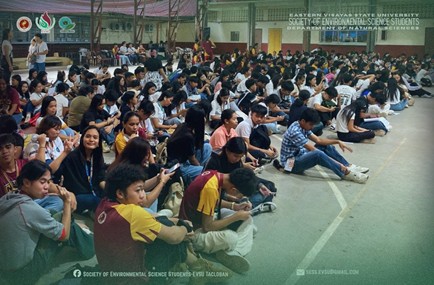
Eastern Visayas State University (EVSU), through its Pollution Control Office, in partnership with the Society of Environmental Science Students, conducted a Waste Analysis and Characterization Study (WACS) Orientation for National Service Training Program–Civic Welfare Training Service (NSTP-CWTS) students on November 15, 2025, at the Inner Court of the Engineering Building, EVSU Main Campus.
The activity aimed to equip students with practical knowledge of waste generation, composition, and proper waste management, emphasizing the importance of responsible waste disposal and environmental protection.
During the orientation, participants were introduced to the basic principles of waste analysis and characterization, including the identification of different waste categories and the importance of proper segregation, reduction, reuse, recycling, and disposal. The discussions also highlighted the provisions and objectives of Republic Act No. 9003, or the Ecological Solid Waste Management Act of 2000, which promotes responsible and sustainable solid waste management.
The activity also provided an overview of the WACS process and safety guidelines, allowing students to better understand how waste characterization helps identify waste-generation patterns and provides essential information for developing appropriate waste-management practices.
Through discussions, question-and-answer sessions, and clarifications, students gained a deeper understanding of their role in promoting environmental responsibility within the university and their respective communities.
The activity concluded with closing remarks and a commitment signing, reinforcing the participants’ shared responsibility in practicing proper waste management and supporting a cleaner and more sustainable environment.
Through initiatives like this, EVSU continues to strengthen environmental awareness and encourage active student participation in building a culture of sustainability.
This article is aligned with Sustainable Development Goals (SDG) 04: Quality Education; SDG 08: Decent Work and Economic Growth; SDG 11: Sustainable Cities and Communities; and SDG 17: Partnerships for the Goals; SDG 12: Responsible Consumption and Production and SDG 13: Climate Action
Via EVSU – BS- EnS